📢 Loạt tính năng mới: Kết nối tài khoản Diễn Đàn với toàn bộ Thư Viện (Truyện/Thơ/Nhạc/Phim/Ẩm Thực)
Xin chào cả nhà!


Ban quản trị vừa hoàn tất một loạt tính năng mới, kết nối tài khoản Diễn Đàn với toàn bộ các khu vực Truyện, Thơ, Nhạc, Phim và Ẩm Thực. Xin tổng kết lại để mọi người tiện theo dõi và sử dụng:

1. Đăng nhập dùng chung toàn site
Chỉ cần 1 tài khoản Diễn Đàn, đăng nhập một lần là dùng được ở mọi khu vực. Nút "Đăng nhập / Đăng ký" đã thay cho "Giới thiệu / Trợ giúp" cũ ở đầu mỗi trang.

2. Thảo luận ngay dưới tác phẩm
Mỗi truyện, bài thơ, bài hát, phim, món ăn giờ có khung bình luận riêng ngay trên trang đọc/nghe/xem - không cần qua diễn đàn mới góp ý được. Bình luận đầu tiên sẽ tự tạo 1 chủ đề trong mục "💬 Thảo Luận Tác Phẩm Thư Viện" để mọi người cùng trao đổi.

3. Theo dõi tác phẩm
Bấm "🔔 Theo dõi tác phẩm" để nhận thông báo qua email ngay khi truyện có chương mới.

4. Yêu thích & Lịch sử đọc
Đánh dấu "⭐ Yêu thích" các tác phẩm ưng ý, và hệ thống tự ghi lại "🕘 Lịch sử đọc" mỗi khi bạn ghé đọc/nghe/xem - đồng bộ theo tài khoản, xem lại bất cứ lúc nào trong menu thành viên.

5. Huy hiệu hoạt động
Một vài huy hiệu nhỏ (bình luận viên, người theo dõi, người sưu tầm, thành viên kỳ cựu...) sẽ tự xuất hiện trên hồ sơ khi bạn hoạt động tích cực - hoàn toàn không phải hệ thống điểm/tiền thưởng, chỉ mang tính ghi nhận cho vui.

6. Ghi công người đóng góp
Tên người đăng nội dung (đánh máy, sưu tầm...) giờ sẽ tự động liên kết về hồ sơ Diễn Đàn nếu trùng với một tài khoản đang có trên diễn đàn.

7. Báo lỗi nội dung
Phát hiện lỗi chính tả, thiếu nội dung, ảnh hỏng... trong lúc đọc? Bấm "🚩 Báo lỗi nội dung" ngay trên trang, không cần rời khỏi tác phẩm đang xem.

8. Cải thiện giao diện trên điện thoại
Đầu trang và khu vực diễn đàn đã được chỉnh lại cho gọn gàng hơn trên màn hình nhỏ.

Rất mong nhận được góp ý thêm từ cả nhà để hoàn thiện dần. Cảm ơn mọi người đã luôn đồng hành cùng Việt Nam Thư Quán!

Diễn Đàn » English Club

Asian Tsunami Disaster

178 trả lời, 32.452 lượt xem — Trang 4 / 6
Former US Presidents Brief Bush on Tsunami Relief
By Paula Wolfson
Washington
08 March 2005


Presidents George H.W. Bush, George W. Bush and Bill Clinton at White House

President Bush got an update on tsunami relief efforts Tuesday from his two predecessors, former Presidents Bush and Clinton. All three stressed the importance of helping the victims of the disaster.

The two former presidents led a national campaign in the United States to raise private funds to help countries devastated by the Indian Ocean earthquake and tsunami. They recently returned from an extensive tour of affected areas.

President Clinton says they were impressed by the will of the people they met to overcome adversity.

"The report basically says that these people have done an unbelievable job dealing with their losses and cleaning up, but there is a lot of work yet to be done, particularly in the hardest-hit countries," he said.

Mr. Clinton says everywhere they went people came up and thanked them for the help extended by Americans, from the aid workers, to the troops who distributed emergency supplies, to those who donated money and time to tsunami relief charities. Former President Bush, the current president's father, says attitudes toward the United States have changed and cites a new poll conducted in Indonesia.

"And it is a dramatic change," he said. "They have seen the kindness, the outpouring of support for the tsunami victims. That has turned public opinion very much in favor of the United States."

The White House says Americans have contributed about one billion dollars to private tsunami relief efforts. President Clinton says recipients of the aid know how deeply individuals half a world away were touched by their plight.

"When you relate to people on a human basis you send a message that our common humanity matters more than our differences," he said. "When people believe that, America wins, the cause of freedom wins. And it was wonderful to see."

A few hours before he came to the White House, it was announced that former President Clinton will be undergoing another round of heart surgery later this week. Mr. Clinton told reporters he will have some fluid drained from his chest and some scar tissue removed that resulted from the heart bypass operation he had last year. But he said, overall, he feels well and joked that before he goes into the hospital on Thursday, he will be playing in a charity golf tournament to raise money for tsunami relief.

http://www.voanews.com/english/2005-03-08-voa61.cfm
Đăng nhập để trả lời
0
Sri Lankan Tsunami Family, Baby, Visit US Congress
By Dan Robinson
Capitol Hill
09 March 2005


Jenita and Murugupillai Jeyarajah with infant son and Tsunami survivor Abilash (Baby 81)

A Sri Lankan couple, and their four-month-old baby, paid a visit to Capitol Hill Wednesday as part of efforts by U.S. legislators to fight woman and child exploitation in the wake of disasters such as the Indian Ocean tsunami.

Baby 81 was the name given by a hospital in Sri Lanka to little Abilash Jeyarajah, who was found in rubble after the tsunami struck in December.

Then two months old, he was the 81st patient admitted in the wake of the tsunami.

After being claimed by at least eight other couples, and making international headlines in the process, he was finally reunited with his parents but not before a legal challenge and a court-ordered DNA test.

This week, parents, Jenita and Murugupillai Jeyarajah, were flown to the United States with their infant son for the first of what has been a flurry of appearances and media interviews in which they talked about their experiences.

One of their stops was the U.S. Capitol, where they stood with two lawmakers announcing the latest response by members of Congress to the tsunami.

The tsunami orphaned thousands of children across the wide area of the Indian Ocean struck by the devastating waves.

Amid concerns many might fall victim to individuals or groups trying to abduct or use them for sexual or labor exploitation, U.S. lawmakers have been exercising their legislative powers to propose laws aimed at helping protect people affected by crisis situations.

With baby Abilash making himself heard in the background, Congresswoman Nita Lowey explained a bill called The Women and Children in Crisis and Conflict Protection Act.

.....

http://www.voanews.com/english/2005-03-09-voa72.cfm
Đăng nhập để trả lời
0
Asian Development Bank Pledges $600 Million in Tsunami Aid
By Tim Johnston
Jakarta
10 March 2005


The Asian Development Bank has promised $600 million in grants to the five countries worst affected by December's Indian Ocean tsunami. The president of the bank, Haruhiko Kuroda, who is visiting Indonesia, says the aid will be carefully monitored to avoid corruption.

The $600 million trust fund is to be distributed to Indonesia, India, the Maldives, Sri Lanka and Thailand. The Asian Development Bank says half the money will go to Indonesia, the hardest-hit country, with more than 220,000 dead and missing, and huge areas swept clean of housing and infrastructure.

Haruhiko Kuroda is the president of the ADB, a non-profit lending organization. After his meetings with Indonesian officials in Jakarta Thursday, he said that bank officials will monitor the funds closely.

"We have to secure assistance actually reaches to the people who need assistance," he explained. "Here we have, of course, many mechanisms to assure that assistance will actually reach the people who need assistance."

He said the bank and the international anti-corruption watchdog Transparency International will hold a meeting in April in Jakarta to look at ways to ensure that tsunami aid is not misused.

Mr. Kuroda also is meeting with Indonesian officials to discuss broader economic issues. He says he believes that the Indonesian economy, currently expanding at just over five percent a year, could grow by more than six percent if foreign direct investment, or FDI, can be attracted to the country.


Tsunami survivor stands at his house at Mulia village in Banda Aceh

"For Indonesia, I think FDI is much needed because domestic consumption recovered, domestic investment is recovering, but FDI is not and if FDI can be attracted more in coming years that would certainly contribute to export growth, investment growth and total economic growth," he said.

He says the private sector will have to play a significant role in attracting investment. He also warns that the government needs to continue tackling corruption and the legal uncertainties that have made investors, both domestic and foreign, wary of putting money into Indonesia.

http://www.voanews.com/english/2005-03-10-voa18.cfm
Đăng nhập để trả lời
0
<Bài viết đã được chỉnh sửa lúc 2005-03-26 23:13:45HongYen>
Americans Recover Record of Couple's Last Moments Before Asian Tsunami
By Rosanne Skirble
Washington, D.C.
03 March 2005

We all know about the power of the Internet to connect people in a community or on opposite ends of the earth. But one family, grieving over the sudden death of two of its loved ones in last December's Asian tsunami, has felt the Internet's power in a remarkable, personal way.

Christian Pilet is a missionary from North Bend, Washington. A month after the December 26th tsunami devastated Indian Ocean coastal communities and killed more than a quarter million people, Christian packed his bags and set off to Thailand to help survivors. Christian and his friend Cameron Craig, a youth minister from Ohio, were walking along a beach strewn with rubble from the tsunami.

In the debris, Christian says, Cameron caught sight of a battered digital camera. "He said, 'Hey look, I found this camera and it is smashed. What should we do with it?' I said, 'I don't know. It doesn't look like it would be much use.' He said, 'Let's take the card out...you never know [what you might find].'"


Christian Pilet put the camera's removable memory card in his pocket and kept walking. Later that night, they loaded the images successfully into Christian's laptop computer.


Camera's last shot of the tsunami


"For us it was absolutely stunning," says Christian. "It was like hearing somebody speak their last words, and then they are cut off mid-sentence. That is how it was. You see this very happy couple having a wonderful time and then the picture of the wave coming. The wave is coming, and then it is there and then there is silence."

Christian Pilet was determined to identify the couple. When he returned home, his wife began to search the Internet for a photo match.

"It was the first hit that she did," he says. "She had done a Google search and pulled it up and she clicked. And she said, 'This is the guy.' And I remember thinking, 'There is no way that you just click and [from] the hundreds of missing people pages that you are going to pick just the one.' And, sure enough, the next morning I got up and looked at it, and it was the one."


John and Jackie Knill enjoying the beach in Thailand before the tsunami

The missing people turned out to be Canadian tourists John and Jackie Knill, both 54. Christian Pilet drove to Canada to deliver the pictures to the couple's three sons. Jackie's sister, Terri Maguire, says the family is comforted knowing how John and Jackie spent their last moments.

"It gave me a sense of calm because I knew they weren't running in terror. But each person in the family has dealt with it a little different," she says. And, having been there in Thailand, Terri's husband Roy adds, "Truthfully, it gave me a sense of peace and closure about the whole issue. It is an end chapter to two beautiful lives."

Terri Maguire says that, ever since their story was picked up by the news media, there has been an outpouring of public sympathy for the Knill family. They've started the Knill Thailand Fund, which has already raised $60,000 to help build a school in a country that John and Jackie loved so much.

http://www.voanews.com/english/AmericanLife/2005-03-03-voa34.cfm
Đăng nhập để trả lời
0
Some Tsunami Aid Groups Stop Seeking Money

Wed Mar 16, 2:26 AM ET U.S. National - AP
By DAVID PACE, Associated Press Writer


A young Indonesian girl cries on her damaged house in Lhoknga, on the west coast in Aceh province. Seismologists say there is a heightened risk that a major earthquake may soon strike the western coast of Sumatra as a result of the monster quake that generated the December 26 tsunami.(AFP/File/Choo Youn-Kong)

WASHINGTON - Despite reconstruction costs estimated at up to $12 billion, several major charities and relief groups have stopped soliciting donations for survivors of December's Indian Ocean tsunami. At least one has begun returning money to donors.

Sensitized by recent charity scandals, agencies say they're being careful not to accept more money than they can legitimately spend to help tsunami victims.

The American Red Cross (news - web sites) and British-based Oxfam stopped raising tsunami relief funds over a month ago, when pledges hit spending targets. Britain's Disasters Emergency Committee stopped last month, for the same reason.

Catholic Relief Services also has ceased active solicitation, with $114 million in hand for $80 million in currently programmed tsunami relief work. Doctors Without Borders (news - web sites) has returned more than $500,000 in donations it couldn't use.

"We didn't want the restricted funds to outpace our capacity to use them effectively in the field," said Nicolas de Torrente, executive director of Doctors Without Borders. "We want to be responsible toward our donors and respect their wishes, that if they give for the tsunami, it will be used for that."

Since the Dec. 26 tsunami killed more than 170,000 people in 11 Asian countries, governments have pledged more than $6 billion in relief and reconstruction funds. The United States initially pledged $350 million, including $226 million the U.S. military spent in emergency relief. President Bush (news - web sites) has asked Congress to increase the overall U.S. aid package to $950 million.

.....................

http://story.news.yahoo.com/news?tmpl=story&cid=519&ncid=519&e=20&u=/ap/20050316/ap_on_re_us/tsunami_relief_3
Đăng nhập để trả lời
0


Thursday, 17 March, 2005, 17:38 GMT

India 'moved east' after tsunami

A seismologist in India says that the country has moved closer to Indonesia due to the massive earthquake which triggered the tsunami in December.
Dr Vineet Gahlaut said that India had shifted a few centimetres eastwards.

He said the earthquake had increased stress on the fault system separating India and Indonesia and heightened the threat of another big earthquake.

Dr Gahlaut made his comments after a one-month survey of the Earth's surface in the Andaman and Nicobar Islands.

Satellite technology

The expedition reveals the geographical distance between India and Indonesia - the epicentre of the deadly earthquake - has been reduced by between five metres and 15mm.

The amount of movement depended on the closeness of different areas to the epicentre of the quake, Dr Gahlaut explained.

[image]
[/image]

The team is not clear when another earthquake will happen

He said that all of the Indian mainland, but not the Andaman and Nicobar Islands - which are on a different tectonic plate - had moved eastwards.

Dr Gahlaut led a four member team of the National Geophysical Research Institute (NGRI) to the Andaman and Nicobar Islands as part of his research, and used satellite technology to make the measurements.

He told the BBC that the 26 December quake had resulted in the eastward movement of the Indian coastal region by a few millimetres.

At the same time, it had caused the Andaman and Nicobar Islands to move westwards by between one metre and 20m.

In the Indonesian island of Sumatra, he said the movement was as much as 20m.

He said that the distance between Hyderabad, Bangalore and Sumatra had been shortened from 10 to 15mm.

Dr Gahlaut's team conducted its study at eight different places in the Andaman and Nicobar islands throughout January.

The BBC's Omer Farooq reports that a worrying part of the conclusions is the revelation that stress on the Sumatra fault system has increased since the 26 December event.

Our correspondent said this indicated that another big earthquake was possible in the region.

But Dr Gahlaut explained that no one could say how big this earthquake would be and when exactly it would come.

Around 10,000 people were killed by the tsunami waves that hit the Indian mainland after the 26 December quake. Thousands more died in the Andaman and Nicobar Islands.

http://news.bbc.co.uk/2/hi/south_asia/4358867.stm
Đăng nhập để trả lời
0

The efforts are now focused on reconstruction


Governments around the world have been urged to honour their financial pledges to the countries worst-hit by the Indian Ocean tsunami.
The Asian Development Bank said there was a shortfall of more than $4bn (£2.1bn) promised for rebuilding India, Indonesia, the Maldives and Sri Lanka.

ADB president Haruhiko Kuroda said the world's attention must stay focused as work moved into reconstruction stage.

Nearly 300,000 people died in the 26 December earthquake and sea surges.

Many thousands more had their homes and livelihoods wrecked.

Corruption fears

The ADB delivered its latest post-tsunami report at an international meeting of donor countries, regional governments and aid agencies in the Philippines capital, Manila.

In his opening speech, Mr Kuroda issued a reminder of the dreadful impact of the waves which pummelled the Asian coast:

in India, 700km (430 miles) of road were damaged

in Indonesia's Aceh province 44% of people lost their livelihoods.

in Sri Lanka, 100,000 homes were lost and 65% of the fishing fleet damaged.
Mr Kuroda said aid agencies and governments needed to improve their co-ordination and spend the money in a predictable, transparent, strategic and effective manner.

"Given the scale of the recovery, even with our best efforts at co-ordination, the potential for gaps, overlaps and duplications is significant," he warned, saying tools needed to be developed to avoid this.

He called on the countries receiving aid to fight corruption and make sure that the money was spent wisely.

His concerns were echoed in recorded messages from former US Presidents Bill Clinton and George Bush Senior.

"They [governments] know that the international community is concerned about the use of funds," said Mr Bush, who toured tsunami-hit countries with his successor in February.

"And they told us they intend to be good stewards of the money raised for their aid," he said.

The Sri Lankan Foreign Minister, Lakshman Kadirgamar, has told the BBC that his country has not yet received any of the money promised by governments - although people all over the world had been generous in their contributions.

http://news.bbc.co.uk/2/hi/asia-pacific/4361053.stm
Đăng nhập để trả lời
0


Monday, 21 March, 2005, 16:51 GMT

Life in a tsunami camp


There is plenty of water but facilities are very basic. However, Kamalini always finds time to bathe her little children. "We must make do with what we have," she says.

..................

http://news.bbc.co.uk/2/hi/in_pictures/4369473.stm
Đăng nhập để trả lời
0
Developers, Villagers Clash Over Land Rights in Tsunami-Hit Areas of Thailand
By Ron Corben, Bangkok
24 March 2005

Ratree Kongwatmai


Private developers laying claim to property in tsunami -devastated areas of southern Thailand are clashing with villagers who say the land is theirs. Ron Corben in Bangkok recently visited Phang Nga Province and reports on one fight to hold on to a beachfront property.

Ratree Kongwatmai lost her home and several relatives, including her father, sister, brother and eight-year-old daughter, when huge waves flattened her village in southern Thailand's Phang Nga Province.

The nightmare did not end there. The 31-year-old now faces the prospect of being thrown off the land in Baan Nam Khem village that she says her family has lived on for at least 30 years.


The Far East Company claims 32 hectares of beachfront land at Baan Nam Khem - including eight hectares that Mrs. Ratree and her neighbors say belongs to them.


Mrs. Ratree says the company has stepped up efforts to enforce its claim since the tsunami struck, telling villagers to stay away from what's left of their homes and urging them to accept compensation to leave the land.

Aid agencies say about 30 Thai villages have become involved in similar land disputes since the tsunami, which killed about 8,000 people and destroyed tens of thousands of homes in southern Thailand on December 26.

Under Thai law, if a person can prove he has lived on a plot of land for at least 10 years he can be granted a title deed.

Mrs. Ratree says she and her neighbors have applied for title deeds to the land, despite being turned down in the past. She has brought together 32 families to build shelters on the land to help press their claim.

Orapin Dawson is an education consultant based in Britain has been helping in the area's recovery efforts. She says their story is distressing.

"When the tsunami came, the business company, who has very much influence, has put the sign on [the land] and tried to evacuate [evict] them," she explained. "But they were living there for 30 years [so] they have no place to stay, they have no place to go."


Far East Company claims it has court support for its bid for a title deed to the disputed land that Mrs. Ratree and other villagers at Baan Nam Khem in Phang Nga province are also contesting
But Mrs. Ratree and her fellow villagers could face an uphill task in claiming the land. The Far East Company has applied to the courts for a title deed and its company's lawyers say the families lack the documents to prove their claim.

A lawyer for the company, Niwat Kaewluan, says Far East bought the land from a tin mining business before the tsunami struck.

Mr. Niwat says the villagers had turned down Far East's offer to build houses on other, smaller plots of land.

"The lawyer says new land surveys are being undertaken in the area," he said. "He also criticizes the people who have moved back on the land because it is necessary to prove who had been living there before the tsunami."

The Coalition Network for Andaman Coastal Community Support has been helping people rebuild their villages and prove their land claims. But spokeswoman Sayamol Kaiyoorawong warns of the legal difficulties, particularly if a company can show it has a title deed.

"If the company has the land rights - the land title deed - generally the court will listen, the court only consider the land title deed," she said.


Area devastated by tsunami

Thailand's surveyor-general, Pairoj Phuekvilai, says the Land Department is looking into such disputes, and making new land surveys. His office oversees surveys for property transactions.

"The people who live without certificate [title deed], now we do the ground survey for them to prove the right," he said. "It means the previous occupier can have [the title] if they occupied the land - then we try to solve their problems after the tsunami."

But the department's effort is expected to take at least two more months.

In the meantime, there are fears that businesses may be unwilling to give way easily and may resort to harsh measures to clear land.

Somchai Homla-or is with the Thai law society, which sent a team of lawyers to the tsunami area to help victims with a variety of legal problems, including land disputes.


Baan Nam Khem in Southern Phang Nga province

"They will use dirty tactics or some bad influence in forcing the people out of the land and in this extent the police become the tool of the business sector in harassing the people or even they enforce the law by accusing the people of encroaching on the land of the businessman," he said.

But Mrs. Ratree says she is not afraid and will press on with her legal fight until she and her neighbors win their title deeds and rebuild their homes.

http://www.voanews.com/english/2005-03-24-voa33.cfm
Đăng nhập để trả lời
0
Monday, 21 March, 2005, 10:29 GMT
Many wander through the ruins of St Peter's church


By Sanjoy Majumder
BBC News, Mullaitivu

The hollowed out shell of St Peter's church lies on the beach in Mullaitivu, in north-eastern Sri Lanka


Just metres from the sea, only the facade remains. The rest was destroyed by December's tsunami.

Chandran Siskandaraja used to attend church regularly, from his fishing village just a few kilometres away.

"I always found solace here. It was a place of refuge from my troubles," he told the BBC News website.

Now he comes here every evening with several other fellow fishermen.

All of them have one thing in common - they are widowers after the tidal wave claimed their wives.

Many of them wander aimlessly through the ruins of the church.

Others sit and gaze out at the sea, in their hand a bottle of arrack, the locally brewed spirit made of palm or rice.

"We have nothing else to do," Chandran says simply.

"There is no-one at home to go back to."

Family torn apart

Nearly 60% of the men in Chandran's village have lost their wives.

It is a situation mirrored along the coast and is presenting a major social problem.

My wife used to wait for me every day with a cup of tea
Antony


"Many of the women died while their husbands survived simply because they weren't strong enough," says Rachel Bernhard, a field delegate with the International Committee of the Red Cross (ICRC).

Others were simply caught unaware.

Antony Karnal had taught his wife to mend his fishing nets, which is what she was doing when the first wave came in.

She grabbed her five children and ran indoors.

Antony, who was outside, managed to survive by clinging on to the branch of a tree.

But his little hut collapsed and was swept away, and with it his family.

In these social set ups, it is the woman who runs the family as a unit
Prof Sivathambi
Tamil scholar


He too comes to St Peter's every day in the late afternoon.

"That's when the local schools let out the children," he says.

"I can't bear to see them - they remind me of my own children. So I come here."

Psychological scar

Antony had been married for 17 years and still struggles to come to terms with his loss.

"My wife used to wait for me every day with a cup of tea when I would come in from the sea," he says, his eyes brimming with tears.

Observers say the trauma of losing their wives has left a deep psychological scar on these men, and many of them are quite simply unable to cope.

"The question of family formation has been deeply affected. In these social set ups, it is the woman who runs the family as a unit," says Professor Sivathambi, a Tamil scholar at Colombo University.

In these heavily male-dominated societies, many say it is difficult for men to be demonstrative of their emotions.

"It is even more difficult when they are fishermen and have to live up to their image as hardened seafarers, able to take on the elements and everything with it," says local teacher Ramanan.

For some of them, it leads to alarming consequences.

I meet Kannan walking on the beach by the church.

His eyes are bloodshot, his shirtsleeve streaked with blood - he has been slashing his arm with a knife.

He lost his wife and his 10-month-old daughter, his only child, in the tsunami.

Once a teetotaller, he has started drinking heavily, locals say.

"Come home with me, I'll take you to my daughter," he tells me.

Somebody comes forward to take him away gently and get him medical attention.

Little help

Aid workers say the psychological impact of the tsunami was the first thing to strike them when they began arriving in the north-east.

Many say the impact was severe on a people already traumatised by years of civil war.

"The family as a unit has been completely stripped bare," says Rachel Bernhard of the ICRC.


Kannan has still to come to terms with the loss of his child


And resolving the problem is not straightforward.

"These men cannot remarry that easily," says Ramanan.

"There are issues of social acceptability, of dowry, of caste to be dealt with.

"They cannot simply marry any woman who is single or willing."

There are other social issues which present a major problem.

"Some of the men have to take care of their children in the absence of their wives," says Ms Bernhard.

It is something they are absolutely unused to.

"It is even more difficult if the children are daughters. It is simply unacceptable socially for a man to be living in close proximity to his girl child," adds Ms Bernhard.

Many of the tsunami victims received counselling from the outset, especially from international aid agencies and religious institutions like the church.

But most of the counsellors targeted young children who had been orphaned - almost none of the fishermen widowers had met a counsellor or had access to psychological help.


'Family backbone'

There are some who say there is a long-term issue to be addressed as well. Women played a vital economic role in fishing families and were pivotal to the marketing of the fish.

"If you go to any village fish market, you will notice that women are the immediate point of sale," says Prof Sivathambi.

As the men come in from the sea with the catch, their wives would help them unload it, sort out the fish and then sell it.

"Men are only the bread earners. Women are the backbone of the family," adds Prof Sivathambi.

"Take them out and it leads to instability."

Sanjoy Majumder


http://news.bbc.co.uk/1/hi/world/south_asia/4360345.stm
Đăng nhập để trả lời
0
If a tsunami struck again next year, the technology would be ready but the people might not


Friday, 25 March, 2005, 13:34 GMT

Tsunami alert technology - the iron link

By Julianna Kettlewell
BBC News science reporter

By December 2006, the Indian Ocean should be fully kitted out with a brand new hi-tech tsunami early warning system.

The arsenal of wave and pressure sensors, seismographs, data-crunching computers and orbiting satellites will cast a watchful eye over the ocean, looking out for any sinister changes.

If another devastating wave takes shape, a warning will fire off immediately and scientists should be able to predict where, when and just how hard the water will hit.

But that is only half the story. Even if the early warning system can be relied upon to do its job, we still cannot breathe easy.

Coasts around the Indian Ocean are often populated by poor communities who do not have access to modern technology. How is every lonely fisherman and every beach dweller without a phone connection going to be warned in the event of an emergency?

The technology goes a long way but the final mile - leading right up to every door across the region - is by far the hardest.

According to some experts, the spanking new technology is the iron link in a dangerously papery chain.

The hi-tech part can take eight months, but to build up to volunteer level will take longer

Eva Vonn Oelreich, International Red Crescent


Effective disaster response drills in surrounding countries are not unachievable - indeed many are working hard towards them - but they are likely to be on a slower timetable than the high-tech installation.

If a tsunami struck again next year, the technology would be ready, but the people might not be.

"I have no doubt that the technical element of the warning system will work very well," said Professor Bill McGuire, of the Benfield Hazard Research Centre, London, UK.

"But there has to be an effective and efficient communications cascade from the warning centre to the fisherman on the beach and his family and the bar owners."

Infrequent reports

Plans to develop the tsunami early warning technology are steaming ahead.

The operation is being co-ordinated by the UN with the help of scientists from all around the Indian Ocean. The final result will resemble the system already existing in the Pacific Ocean, and will be able to pick up storm surges (big waves caused by storms) as well as tsunami.

The Indian Ocean already has 15 sea level gauges, which broadcast information about changes in water swells. At the moment, they only generate data every hour or so, which is clearly far too infrequent for effective tsunami detection.

But after an upgrade, these sensors will send sea-level updates every three minutes.

"The upgraded instruments will be able to measure sea level accurately and also broadcast it at a faster rate to international centres," said Patricio Bernal, of the United Nations Educational, Scientific and Cultural Organization's (Unesco) Intergovernmental Oceanographic Commission (IOC).

"We expect this to be complete within the next few months."

The next stage will be to install a series of pressure gauges, which sit under the sea and monitor the weight of water on top of them. They transmit data to a buoy floating on the surface, which relays the information to a satellite that alerts a computer in an international early warning centre.

The pressure gauges are expensive pieces of equipment - each buoy unit costs $300,000 (£160,000). The UN has not yet decided how many buoys will be installed, but it is likely to be several.

The Pacific Ocean has several million dollars worth of early warning equipment and, although nobody is able to put a figure on the Indian Ocean system, it will probably be in the same ball-park.

All the ocean sensors and seismographs will broadcast their information first to an international early warning centre and then on to national centres.

Emergency response

It is there that the iron link ends. Although the UN is overseeing the technology installation, it will be up to individual governments to co-ordinate and plan their own emergency responses.

"I think there is a lot to do there," admitted Dr Bernal. "Usually, emergency infrastructure is not very high on the list of priorities for most governments.

"Detecting a tsunami is only a fraction of the problem - the big problem is how to prepare societies and local populations so they can act appropriately to a warning."


The Pacific system works in quite a simple way


The International Red Crescent Society is working with individual governments to help them develop their emergency strategies.

They say that, because the tsunami risk is actually extremely low, the important thing is to take a multi-hazard approach - otherwise, over the years, interest will fade. In other words, people will be taught how to behave in the event of a cyclone, earthquake, storm surge or tsunami.

"Even after a year, you see how the interest is fading," said Eva Vonn Oelreich, head of disaster preparedness at the humanitarian society. "That is why we strongly advocate a multi-hazard response."

Each community with a high hazard risk will contain a series of volunteers. These are the people who will be told first about an impending disaster and they will inform their local population.

They may have hand megaphones or whistles and will cycle around their villages warning people.

The community as a whole could be trained how to react to this warning through a series of live performances.

"In Bangladesh, which suffers badly from cyclones, the preferred way to raise awareness is through dramas," said Ms Vonn Oelreich.

"The volunteers perform as if in a disaster. You see women on their own rushing to get to evacuation centres, which is very important because women cannot always go out alone and we need to show that in situations like this different rules apply."

However, this type of effort takes a long time to achieve results.

"It is an enormous job," said Ms Vonn Oelreich. "After three years you have solid work on the ground, but it is not institutionalised unless you see it can work for a 10-year period.

"The hi-tech part can take eight months, but to build up to volunteer level will take longer. It will be quite a few years before the communities are trained in alert signals and evacuation mechanisms."


Đăng nhập để trả lời
0
<Bài viết đã được chỉnh sửa lúc 2005-03-26 23:47:13HongYen>

UNHCR logo


By Lisa Schlein
Geneva
25 March 2005

The U.N. Refugee Agency says it is leaving tsunami-hit Aceh Province at the request of the Indonesian authorities. The agency says it expects its withdrawal to be completed by Saturday.

The U.N. Refugee Agency says it is leaving Aceh because the emergency phase of the huge international relief effort is ending and the long-term reconstruction phase is set to begin.

UNHCR Spokeswoman, Marie-Helene Verney says there are hundreds of international and private aid agencies working in Aceh. She says the Indonesian government has said it would only allow those foreign agencies that are involved in large scale rehabilitation to remain.

"We have been talking with the government and our impression was that they consider that we were not amongst the most needed agencies," Ms. Verney said. "It is true that we have a six-month program there. We have done about three months of it. We are handing over what we have done, so it is not all going to stop. It is being handed over to the government and to other U.N. agencies and, indeed, the NGOs [non-governmental organizations]."

Ms. Verney says the agency is disappointed at having to leave. And, she says, UNHCR representatives have told the Indonesian authorities they are prepared to continue working in the tsunami ravaged province if needed.

The UNHCR's mandate is to protect refugees fleeing violence and persecution. It does not normally respond to natural disasters.

Ms. Verney says the agency got involved at the request of U.N. Secretary-General Kofi Annan who asked the UNHCR to take the lead in providing shelter to 100,000 homeless victims of the disaster because of its experience in dealing with emergency situations.

Aceh rebels have been involved in a long war for independence from Indonesia. The UNHCR, at times, has been at loggerheads with the government over the treatment of ethnic Acehnese refugees who had been forcibly returned. Several years ago, it ran into problems with the Indonesian authorities over the breakaway province of East Timor.

Ms. Verney denies reports that the Indonesian government asked the UNHCR to leave because it distrusts its presence in this volatile area.

"The relations that we have with the authorities on the ground in Banda Aceh for the past three months have really been very good," she said. "So, I do not think this has anything to do with what has happened in the past. We are not the only agency that is going to leave. We might be the first one, but we are not the only one. I mean more people are going to go in the next few weeks. So, we are not being singled out, in other words."

Ms. Verney says the UNHCR has about 3$3 million left for tsunami relief operations in Aceh. She says the agency will ask donors how it should use the funds not already spent. She says the agency would like to use the money for other underfunded operations, such as the one in Sudan. But she says it is up to the donors to decide.

http://www.voanews.com/english/2005-03-25-voa23.cfm
Đăng nhập để trả lời
0
Saturday, 26 March, 2005, 00:27 GMT
Most tsunami dead female - Oxfam

In four villages in Aceh Besar district 189 of 676 survivors were female


More women than men were killed by the Asian tsunami, Oxfam figures from India, Indonesia and Sri Lanka suggest

In some regions the disaster claimed four times as many women as men.

The charity says women were worst-hit because they were waiting on beaches for fishermen to return, or at home looking after children at the time.

The research comes exactly three months after the under-sea earthquake caused a wave that devastated coastlines around the Indian Ocean.

Oxfam International focused their research on the Indonesian province of Aceh, the Cuddalore district of India, and took data from camps across Sri Lanka.

In four villages in Aceh Besar district only 189 of 676 survivors were female - men outnumbering women three to one.

'Disproportionate impact'

In four villages in North Aceh district, 82 men died, compared to 284 women.

A staggering 80% of those who died in Kuala Cangkoy in North Aceh were women.

This disproportionate impact will lead to problems for years to come unless everyone working on the aid effort addresses the issue now

Becky Buell
Oxfam policy director


India suffered a similar fate with three times as many women being killed as men in Cuddalore district - the second most seriously affected area in India.

In one Indian village, Pachaankuppam, the only people who died were female.

The story is the same for Sri Lanka where the number of male survivors in the emergency camps far outweigh the women.

Becky Buell, Oxfam's policy director, said the tsunami had dealt a "crushing blow" to both women and men.

"This disproportionate impact will lead to problems for years to come unless everyone working on the aid effort addresses the issue now."

She said there are already reports of rapes, harassment and forced marriages coming from emergency camps around the region.

She urged people to "wake up" to the issue and ensure "protection, inclusion and empowerment" of female survivors.

Errands

The report suggested a number of reasons for the high proportion of female deaths.

On the Indian coast many women were waiting for the fishermen to return with their catches, while in Batticaloa on the east coast of Sri Lanka, the tsunami hit at the exact moment many of the women were taking baths in the sea.

Because it was a Sunday, many of the women in Aceh were at home with the children rather than at work.

The men in most parts of Aceh were either carrying out errands or in their boats out at sea, where the waves were less ferocious.

Ms Buell called on governments and NGOs to help ensure women are given the same opportunities as men to rebuild their lives.

She added it is important to work with men who had lost their wives and teach them how to care properly for their children.

http://news.bbc.co.uk/1/hi/world/asia-pacific/4383573.stm
Đăng nhập để trả lời
0
<Bài viết đã được chỉnh sửa lúc 2005-03-29 04:55:58HongYen>
Tsunami alerts cause panic across Asia after huge quake off Indonesia

1 hour, 15 minutes ago South Asia - AFP

Mon, Mar 28, 2005

BANDA ACEH, Indonesia (AFP) - A huge earthquake off the coast of Indonesia triggered tsunami alerts across Asia, causing widespread panic in countries where over 270,000 people were killed by giant waves just three months ago.

The undersea quake measuring over 8.0 on the Richter Scale prompted India, Malaysia, Sri Lanka and Thailand to join Indonesia in issuing tsunami alerts. Unconfirmed television reports said "tens of people" had been killed on the remote Indonesian island of Nias.

However nearly three hours after the quake struck off the northwest Indonesian coast, Indonesian and Thai meteorological officials gave the all clear and said it appeared the quake had not caused any tsunami.
.....
http://news.yahoo.com/news?tmpl=story&u=/afp/20050328/wl_sthasia_afp/asiaquake_050328200231

...............................

http://www.bbc.co.uk/vietnamese/regionalnews/story/2005/03/050328_earthquake.shtml


Đăng nhập để trả lời
0
Indonesia: Relief Operations Fully Underway

By Nancy Collins
Gunung Sitoli, Indonesia
01 April 2005

Relief operations are fully underway on Indonesia's Nias Island, by the third day after an eight-point-seven magnitude earthquake struck the region, killing hundreds of people. VOA's Nancy-Amelia Collins filed this report from the Nias capital, Gunung Sitoli. It is narrated by Ernest Leong.


After trickling in for two days, aid to the shattered island began pouring in Thursday, with international aid organizations and the Indonesian military ferrying in water, food and medicine.

Scores of people sought refuge in temporary shelters in the island's capital, Gunung Sitoli.

As many as 30 percent of the town's buildings were destroyed when the quake struck late Monday. It came just three months after a magnitude nine quake in the same area sparked a tsunami that killed over 300,000 people across the Indian Ocean region.

Indonesian President Susilo Bambang Yudhoyono visited the island Thursday, and promised to take quick action to help residents, including getting the electricity running again.

The president says, in this emergency situation, the people of Indonesia must unite to overcome their hardships and rebuild their lives.

While Nias bore the brunt of the damage -- 500 of the 518 reported deaths occurred there, according to a UN survey -- Simuelue and Sumatra Islands were also affected.


Brian Williams

Brian Williams, who owns a resort on Simeulue says, "I just had a call from the governor of the island who said that the world is not helping Simeulue. We need help in Simeulue so I'm organizing boats now."

There are deaths, destroyed buildings and traumatized survivors, including Juan Pedro Garcia.

"At the moment, I think it's just too uneasy. There's too much damage. No one knows what's going on. It's all up in the air at the moment. We just don't know," says Juan.

The full extent of the damage remains unclear, as rescue efforts continue.

http://www.voanews.com/english/2005-04-01-voa12.cfm

Đăng nhập để trả lời
0

A fishing boat sits atop a house near a refugee camp, Tuesday, March 22, 2005, in Banda Aceh


Meeting Addresses Tsunami Aid Accountability

By Nancy-Amelia Collins
Jakarta
08 April 2005

A fishing boat sits atop a house near a refugee camp, Tuesday, March 22, 2005, in Banda Aceh
Following the devastating earthquake and tsunami in the Indian Ocean last December, billions of dollars in aid was pledged to countries hit hard by the disaster. Not too long afterward, people started expressing concern that the donated funds might be misused. International experts met in Jakarta to discuss ways to ensure the aid gets to those who need it.

The experts say transparency and accountability are the keys to safeguarding the estimated $5 billion in aid pledged for the tsunami-affected countries.

The conference was called to discuss ways to minimize corruption in the distribution of aid. It was organized by the Asian Development Bank and the Organization for Economic Cooperation and Development and attended by a slew of corruption experts from the public and private sectors throughout the Asia-Pacific region.

Jak Jabes of the Asian Development Bank says cooperation among governments and aid donors is essential to fight corruption.

"Those stakeholders involved in tsunami assistance must ensure transparency and accountability in their operations,” said Mr. Jabes. “In particular in the management of the financial flows. For this, up-to-date information must be made actively available to any interested party."

The majority of aid will go to rebuilding Indonesia's province of Aceh, the region worst hit by the December 26 earthquake and tsunami. Indonesia is consistently rated as one of the most corrupt countries in the world, and donors are worried about how well their contributions will be monitored.

Mr. Jabes says the answer to these concerns lies in organization and coordination.

"Donors should coordinate with governments and among themselves to avoid duplication of assistance schemes,” he added. “They should also establish uniform procurement rules, maintain and publish clear books and records and provide assurance of full internal and external controls. They must further make a careful assessment of the local conditions so that allocated resources match needs."

Conference participants say the meeting was the start of a long-term process of fighting corruption and promoting transparency in reconstruction aid, which will extend beyond the immediate post-tsunami period.

http://www.voanews.com/english/2005-04-08-voa80.cfm
Đăng nhập để trả lời
0
Monday, 11 April, 2005, 12:27 GMT 13:27 UK
Tsunami children get puppet help
By Steven Shukor
BBC News website


Dr Jones says the children make a connection with the puppets


Lynne Jones could see that the brightly coloured bird puppet in her hand had the silent Indonesian girl captivated.

The six-year-old had not spoken since the 26 December Indian Ocean tsunami swept away her village of Lamno, on Aceh province's west coast, taking her mother with it.

Rosie survived only by clinging onto a palm tree, and was rescued after two days, crying for her mother.


Her grandmother brought her to Dr Jones, a child psychiatrist with the International Medical Corps (IMC), a humanitarian organisation providing mental health assistance to the tsunami-hit region.

With 15 years experience working with children in disaster zones from Kosovo to Indonesia, Dr Jones has found "play", including puppetry, to be an effective means of communication.

Puppets are one step away from being human and so there is distance but at the same time we can identify with them

Dr Lynne Jones
She admits to never leaving home without her bag of toys which contains among other playthings, a menagerie of finger-puppets and hand puppets, including tigers, birds, turtles, monkeys and crows.


In the wake of the Asian tsunami, she discovered that many young survivors were ignorant of what had befallen them and she started information workshops using puppets to explain the tsunami.

"The puppets are all animals. They are all culturally neutral and they can take on different roles," she says.

"Puppets are one step away from being human and so there's distance but at the same time we can identify with them."

She has taken care not to include puppets of humans, pigs or dogs - taboo for Muslims in Aceh.

She uses the puppets to explain the tsunami - its causes and effects -, how to avoid getting caught up in one in the future and to help the youngsters deal with their loss.


Play therapy

She also uses the puppets for child therapy. With the support of an interpreter, she created a simple scenario based on Rosie's own experience but set in a different context.

She had gleaned information about Rosie's story from speaking to her grand-mother and other family members.

She laid out several puppets on the mat before the little girl.

"She was very interested," says Dr Jones. "She chose the little bird. We gave the little bird the girl's name."


[The children] see that somebody is acknowledging the painful thoughts and feelings they have

Dr Jones
Dr Jones made up a story of a young bird living in a tree with her mother.

"The wind came and blew all the birds in the forest away. The little bird clung on and managed to survive but her mother had gone."

Dr Jones expressed this by throwing the mother-bird puppet away from her hand.

"People who see me do this asked me: 'How can you do this? It's too shocking for them'.

"But it is not shocking to the children because they are thinking about it all the time.

"They see that somebody is acknowledging the painful thoughts and feelings they have."

The stranded little bird is eventually rescued by a monkey who takes her to meet other members of her family who survived.


"After a very long time the little bird started to feel better and wanted to sing again," Dr Jones told Rosie.

At the end of the session, Dr Jones said the little girl wanted to take the bird home with her.

She came back the following week and brought her cousin whose parents had died, who also wanted a story.

Although the healing process will be a long one, Dr Jones says the girl has since started speaking again and is making new relationships with surviving family members.

In the days following the tsunami, the IMC sent teams of doctors and nurses to provide emergency medical relief in Aceh as well as Sri Lanka.

Outsiders can listen. It is as simple as that. People want to feel that what has happened to them is significant

Dr Jones
That work has now evolved into a variety of programmes including one to develop long-term community-based mental health services, which involves training primary health care staff.

Dr Jones has found that being an outsider is a real benefit in helping survivors of mass disasters.

"In normal circumstances if a loss occurs your neighbours and friends will rally round and support you.

"But when everyone is affected, everyone protects everyone else by not talking in order not to burden them, and there is a feeling that one's own individual losses are somehow without meaning in the larger catastrophe.

"Outsiders can listen. It is as simple as that. People want to feel that what has happened to them is significant," she said.

http://news.bbc.co.uk/2/hi/asia-pacific/4416267.stm
Đăng nhập để trả lời
0
http://news.yahoo.com/news?tmpl=story&u=/afp/20050421/en_afp/asiaquakeczechnemcova_050421153448

Thu Apr 21,11:34 AM ET

Czech tsunami victim Nemcova plans a book about her experience

PRAGUE (AFP) - Czech supermodel Petra Nemcova, who was seriously injured in the Asian tsunami last December, said she wants to write a book about her experience, local media reported.


The 25-year-old model broke her pelvis and suffered internal injuries and survived by clinging to a palm tree for eight hours after her beach cabin was destroyed and she was swept away by the water.

Her boyfriend, British photographer Simon Atlee, 33, died in the disaster.


"I want to help people and give them strength. Each of us confronts tragedies in our lives and I want to show how I fought bad luck," added Nemcova, who still uses crutches to get around following the pelvis fracture.

The model, a celebrity particularly in the United States, confirmed that she wanted to return to Asia to help victims of the catastrophe.

"I will be in Thailand in May with my sister, father and friends.. We want to build something. Maybe a school," she told the Czech daily Mlada fronta Dnes.

Nemcova and Atlee had been on a seaside holiday in Thailand when the disaster struck.

After being rescued the model spent time in a Thai hospital and was then flown to a Prague hospital in early January.

.....................


Người mẫu Petra Nemcova.


http://www.vnexpress.net/Vietnam/Van-hoa/Guong-mat-Nghe-sy/2005/04/3B9DD863/
Đăng nhập để trả lời
0


Sri Lankans seek miracles amid tsunami tragedy
09 Jan 2005 08:25:41 GMT

Source: Reuters

By David Fox

GALLE, Sri Lanka, Jan 9 (Reuters) - Amidst the grief and mourning following the Indian Ocean tsunami that flattened coastal Sri Lanka, it is hardly surprising that the nation is searching the rubble for miracles to lighten their spirits.

On Sunday they appeared to get one when Sri Lankan newspapers reported salvage workers had rescued a man from the rubble of a building that had been flattened by the deadly waves 14 days ago.

"A miraculous story of survival," said The Sunday Times, adding H.G. Sirisena was being treated at a Galle hospital for a broken arm and mild pneumonia.

Unfortunately, while Sirisena's story is tragic, it appears to be neither miraculous nor true.

Doctors at Karapiteya Hospital near Galle confirmed on Sunday that a man had been brought to hospital the day before and his rescuers had said they had found him beneath the rubble from a collapsed building at Pettigalawatta, a suburb near the port that is home to numerous small warehouses and residences.

But when pressed, doctors refused to say if they believed his injuries and condition were consistent with someone who had been trapped alive for 13 days beneath a collapsed building.

"The nation needs miracles at this time," one doctor said on condition of anonymity. "We only know what we have been told. Who are we to say what has and hasn't happened."

Sirisena himself has hardly spoken a word since being admitted -- seemingly slipping into unconsciousness whenever medical staff approach him.

"He told us that the last thing he remembered was a gunshot," said Aden Rathnaweera, chief nurse at the hospital. "And he told us his name. He doesn't remember anything else."

At the site itself, rescue workers spoke proudly of how they had pulled Sirisena from the rubble.

"I saw him first," said Ashoka Ratnayake, a teacher from Matale.

But then politics -- never far from the surface of Sri Lankan life -- joins the story.

"Me and the other JVP (People's Liberation Front) volunteers found him. We saved him and took him to hospital."

HIGH-PROFILE CAMPAIGN

The JVP, a hardline Sinhalese nationalist junior partner of the coalition government, is mounting a high-profile post-tsunami clean-up and reconstruction campaign in Galle, and teams of volunteers wearing party badges can be seen sweeping the streets and clearing debris.

B.M.D.K Bandaranayake, whose identity says he is a Ministry of Transport and Highways technical officer based in Matale, was also wearing a JVP badge and said he was a volunteer rescue supervisor.

"The JVP have done a tremendous job here," he said, declining to say why his expertise was not being used in an official capacity.

Local residents, however, poured cold water on their claims.

One said Sirisena could have been a looter, picking through the rubble for something valuable to salvage, slipped and broken his arm.

"There have been gunshots around here. The police fire to scare off looters," he said.

Others were more specific.

"I saw him walking around in the days before he was found," said W.D. Somasiri Wijowoora, who lives on Cross Road, scene of the rescue.

"We have seen him around the area a few times since the tsunami. He seems to be a bit crazy. We have offered him food and clothes but he refuses."

Wilson Vikram, another resident who is also a JVP member but not involved in the clean-up, added:

"I am sure the tsunami affected him, but he was definitely not trapped since then. We have all seen him. This is nonsense."

In the aftermath of the tsunami, Sri Lankan newspapers have been filled with miracle stories -- most, unfortunately, do not stand up to scrutiny.

Media reported that because of their "sixth sense", not a single wild animal was killed in Yalla National Park, but Reuters correspondents saw the bodies of deer and mongoose just two days after the disaster.

Much has also been made of the miracle that meant not one single Buddha statue was damaged by the tsunami -- even when the temples in which they were housed were destroyed.

While it is true many statues did escape, a more plausible explanation is that builders generally put their best materials and workmanship into the construction of statues, and the temples less so.

In any event, Reuters correspondents saw numerous damaged statues along the coast. One near Matara was seen repaired 10 days later and a monk holding court, telling visitors about the miracle -- for a small donation.

As for Sirisena, only he knows his real story.


On Sunday he lay on a hospital bed, arm in cast, curled up in a foetal position.

"He is still not speaking," said Dr Lalith. "Perhaps he is afraid he will get into trouble. Who knows?"

http://www.alertnet.org/thenews/newsdesk/B530548.htm
Đăng nhập để trả lời
0
<Bài viết đã được chỉnh sửa lúc 2005-05-11 07:05:44HongYen>


Tens of thousands of Acehnese remain homeless


Monday, 9 May, 2005, 14:14 GMT 15:14 UK

Aceh restoration 'close to zero'


The Indonesian official co-ordinating the recovery of tsunami-hit Aceh has said reconstruction there has hardly begun, five months after the disaster.
Kuntoro Mangkusubroto said he was shocked at how little had been done for almost 600,000 survivors who lost their homes on 26 December 2004.

Indonesia had been too slow to set up the agency he heads, and $5bn (£2.7bn) in aid had not been disbursed, he said.

Mr Mangkusubroto said bureaucracy might delay the money for four more months.

'No roads or bridges'

Mr Mangkusubroto told reporters that while some rehabilitation work had been done, it was "close to zero".

There is not enough food for the kids

Kuntoro Mangkusubroto
Reconstruction co-ordinator
"Roads? There are no roads being built. Bridges? There are no bridges being built. Harbours? There are no harbours being built," he said.

He said part of the problem was that foreign governments were waiting for his agency to be up and running before handing out the billions of dollars they had pledged.

Defenders of the aid effort say they are doing their best in the face of overwhelming suffering. They say they need to move with deliberation to avoid misdirected or duplicated assistance.

The BBC's Tim Johnston in the Indonesian capital, Jakarta, says Mr Mangkusubroto's comments echo the increasing frustration of many Acehnese at what they feel is the relatively slow pace of reconstruction.

More than 165,00 people died or are assumed dead in Aceh, as a result of the earthquake and tsunami. A further 600,000 were left homeless.

In total, some $10bn has been pledged for relief and reconstruction for the countries around the Indian Ocean, and the bulk of that money is expected to go to Indonesia, the hardest-hit country.

Situation 'shocking'

Mr Mangkusubroto, who took up his position just over a week ago, accused the Indonesian government of dragging its feet.

"There is no sense of urgency," he said.

Mr Mangkusubroto, who has just visited Aceh, said the situation there was "shocking".

"There is not enough food for the kids... at least there should be some food."

He said the key to the problem was co-ordination, and he promised to provide the needed direction.

And he pledged to take a tough stand towards anyone in his agency found misusing funds, saying they would be subject to double penalties under Indonesian law, including prison terms.


http://news.bbc.co.uk/1/hi/in_depth/world/2004/asia_quake_disaster/default.stm
Đăng nhập để trả lời
0
Aceh restoration'close to zero'

BBC 9 May 2005

http://news.bbc.co.uk/2/hi/asia-pacific/default.stm
Đăng nhập để trả lời
0


Monday, 18 April, 2005, 11:41 GMT 12:41 UK

Tsunami: Anatomy of a disaster
An account of the Asian tsunami disaster based on scientific research and survivors' stories

http://news.bbc.co.uk/1/hi/in_depth/world/2004/asia_quake_disaster/default.stm
Đăng nhập để trả lời
0
US Official Pledges New Tsunami Aid for Aceh
By Tim Johnston
Jakarta
08 May 2005


Robert Zoellick


U.S. Deputy Secretary of State Robert Zoellick has visited the Indonesian province of Aceh, where more than 165,000 people lost their lives and 600,000 were made homeless in last December's earthquake and tsunami. Mr. Zoellick unveiled another huge U.S.-funded aid project, to add to the help the United States has already provided for the victims of the disaster.

The United States has been among the leading providers of assistance to the hundreds of thousands of survivors of the Indian Ocean earthquake and tsunami, and in Indonesia Sunday, Deputy Secretary of State Robert Zoellick vowed to continue the help.

He signed a pledge to rebuild the vital road that runs along the northwestern coast of Indonesia's Sumatra Island, a project the U.S. Army Corps of Engineers estimates will cost in the region of $240 million.

The project is just part of the $1 billion in public and private funds pledged by the United States for the worst-hit countries around the Indian Ocean. Aceh, which accounts for more than half the total tsunami dead, will get the bulk of those funds.

But there have been concerns about money being lost to Indonesia's endemic corruption. In meetings over the past two days, including a visit with Indonesian President Susilo Bambang Yudhoyono, officials have sought to reassure Mr. Zoellick, pointing out the extensive measures they have put in place to ensure accountability.

Mr. Zoellick says the world is watching.

"I certainly have a sense the Indonesian government is highly sensitive to the fact that the eyes of the world will be on it. The money needs to be well spent," he said.

More than four months after the original 9.1 magnitude earthquake and tsunami hit, Aceh is starting to rebuild.

The road the United States has promised to repair will be a lifeline for many of the hardest-hit villages in Aceh, which are currently being supplied by boat and helicopter.

http://www.voanews.com/english/2005-05-08-voa9.cfm
Đăng nhập để trả lời
0
Former US Presidents Appeal for Continuing Aid for Tsunami Victims

By Stephanie Ho
Washington
12 May 2005


Former President George H.W. Bush, left, looks on as former President Bill Clinton talks about tsunami relief efforts


Former Presidents Clinton and George H.W. Bush are urging the world to keep up interest in recovery and rehabilitation efforts following December's massive tsunami that hit Southeast Asia the hardest. Meanwhile, officials say they are taking precautions to ensure that the unprecedented amount of contributions following the natural disaster will not be lost to corruption.

Shortly after the tsunami disaster, President Bush named his father, George H.W. Bush and his predecessor, Bill Clinton, to lead U.S. efforts for private contributions. To date, American companies have donated more than $500 million in cash and material contributions.

Former President Bush said this is less than half of the total private contributions from Americans, a number he describes as "staggering."

"Some are estimating these kinds of private donations, nationwide, exceed $1.2 billion."

Former President said the donations already have had positive concrete results, including helping to avert widespread shortages of food and outbreaks of diseases in the affected areas.

He spoke at a meeting in Washington sponsored by several groups, including the Asia Society and the Asia Foundation. The gathering brought together officials from the region to discuss the current state of post-tsunami recovery and rehabilitation efforts.

Former President Clinton said the time between now and the end of the year will be crucial for tsunami survivors.

"This is the hardest period, because it's out of the newspapers," he explained. "All the dead who could be found have been buried. People have got to put their lives back together. And the monsoon season is coming, and there are still some people in tents, thousands of them."

Also at the meeting, United Nations Undersecretary for Humanitarian Affairs, Jan Egeland, acknowledged that the reconstruction efforts have been slow. But he added that international organizations working in the tsunami-affected areas are trying to ensure transparency and accountability.

"Because what we cannot afford is scandals, any kind of scandals, and that money goes in the wrong direction or into the wrong pockets, because we have such an unprecedented generosity and also, such unprecedented needs to be filled," he noted.

The issue of corruption on the ground was addressed by Indonesia's National Development Planning Minister Mulyani Indrawati.

"I think we are very aware that for this rehabilitation and reconstruction, the reputation of this implementing agency is at stake and we are fully committed to implement all this rehabilitation and reconstruction activity with a high standard of governance, transparency and accountability," she noted.

Ms. Mulyani said some measures her government is implementing include independent supervisory boards to oversee aid distribution, a private sector liaison office and a website that will provide public information on various government projects.


http://www.voanews.com/english/2005-05-12-voa72.cfm
Đăng nhập để trả lời
0
<Bài viết đã được chỉnh sửa lúc 2005-05-15 23:25:00HongYen>
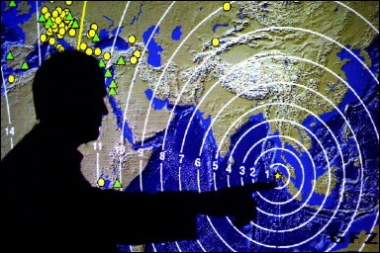
AFP/DDP/File - Sat May 14, 5:37 AM ET File

Points on a map

File picture of a professor of geophysics, points on a map displaying the propagation of the seismic waves after the Sumatra quake of December last year. An earthquake measuring 6.9 on the Richter scale rocked parts of Indonesia's Sumatra island, renewing fears of a tsunami but there were no immediate reports of casualties or damage.(AFP/DDP/File /Michael Urban)

http://story.news.yahoo.com/photos/ss/events/wl/122604indonesiaquake/im:/050513/ids_photos_wl/r1435782542.jpg?sp=-1&lsp=6000

📎 Earthquake
Đăng nhập để trả lời
0
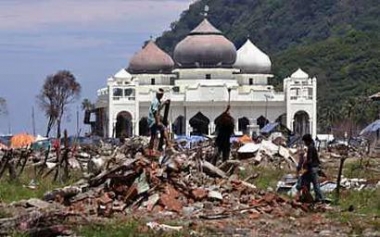
Collecting scrap metal

Acehnese men collect scrap metal near a mosque in Lampuuk, an area hit by the December 26, 2004 tsunami, on the outskirts of Banda Aceh in the Indonesian Aceh province in this April 4, 2005 file picture. Photo by Steve Crisp/Reuters

http://story.news.yahoo.com/photos/ss/events/wl/122604indonesiaquake/im:/050513/ids_photos_wl/r1435782542.jpg?sp=-1&lsp=6000

📎 Muslim
Đăng nhập để trả lời
0
Big donors get mixed score card on tsunami aid

By Tim Large
Wed May 18,12:28 AM ET


LONDON (Reuters) - The biggest donors to the aid effort after the Asian tsunami have made spending plans for less than 60 percent of the billions they promised, raising doubts about the pace of rebuilding five months after the disaster.

Offers of aid poured in after the giant waves that killed 228,000 people and wiped out the homes and livelihoods of an estimated 5 million people on Dec. 26.

But aid allocation figures show just 58 percent of the $5.3 billion promised by the top 10 donor governments and multilateral organizations has been disbursed, committed or budgeted for specific programs.

That leaves $2.2 billion of pledges not earmarked and which governments and aid agencies in tsunami-hit countries will struggle to include in planning as relief efforts give way to reconstruction, according to research by humanitarian news Web site Reuters AlertNet.

"Almost five months on, it seems that some rich countries are still dragging their feet," said Jasmine Whitbread, international director of British aid agency Oxfam.

"Until governments honor their aid pledges, the recovery and rebuilding process will be in doubt."

Even where the money is available and ready to be spent, there is the problem of ensuring it goes where it is really needed.

APPROPRIATE PROJECTS

"You're in this classic phase at the moment ... where you've got the destitute Sri Lankan fisherman standing on a beach, for any international journalist to talk to, who's going to say 'Where the hell's the aid'," said Joel Charny, vice president of policy at U.S. advocacy group Refugees International.

"But you do want to be responsible. You want to invest that money appropriately."

That is no small task, considering the spread of countries hit by the tsunami -- Indonesia, Myanmar, Thailand, Malaysia, India, Sri Lanka, the Maldives, Bangladesh, the Seychelles and Somalia.

"Our challenge now is not in financing but in reallocating funds from overfunded relief projects to underfunded reconstruction programs," Jan Egeland, the U.N. relief coordinator, told Reuters.

"Getting all local, national and international actors to agree on a coherent development effort is going to be even harder than meeting the emergency needs."

'PLANNING TAKES TIME'

The United States, which has pledged the most to the tsunami effort, has so far committed $366 million or 43 percent of its $857 million promise of specific tsunami-related aid, according to Reuters AlertNet research.

That includes $226 million in military assistance.

The calculations of the value of promised aid take into account grants, military support, debt relief and the cost of concessionary loans.

The U.S. pledge was only set in stone last week, after months of wrangling over an $82 billion emergency spending bill that included extra funds for military operations in Iraq.

Mark Ward, a senior official at the U.S. Agency for International Development, said Washington would announce a string of aid commitments in coming weeks, including final plans for a $245 million highway project in Indonesia's Aceh province.

"If Congress had moved faster, we probably wouldn't have spent it any faster," he said, citing the need for transparency and accountability and proper project assessments.

Washington has already signed memorandums of understanding with recipient countries on several projects including the Aceh highway, but the funds have not yet been committed officially.

Australia, Germany and the Netherlands have all allocated less than 20 percent of their respective pledges of $739 million, $643 million and $309 million.

Australia's pledge includes up to $389 million in interest- free loans to Indonesia that would cost the Australians an estimated $350 million if taken out in full. The Canberra government said none of the loans had yet been granted.

Other donors were much quicker to set their spending plans.

QUICK WORK

Japan, keen to carve out a global aid leadership role to match its economic might, disbursed all $500 million of its initial pledge within days of making it, then threw in an extra $40 million in grants on top of $11 million in military support.

The Asian Development Bank, the European Commission and Norway have pinned down more than 95 percent of their pledges, allocating $655 million, $583 million and $173 million respectively.

"We've earmarked funds so the governments concerned know where they stand," said Emma Udwin, EC spokeswoman for external relations. "But there hasn't been some unseemly rush into programming our tsunami assistance. We held back until needs assessments had been carried out."

Britain has allocated 70 percent of a $465 million pledge that includes funds for humanitarian assistance, reconstruction, debt relief and tax forgiveness on private donations.

Canada has budgeted 37 percent of its multi-year pledge of $341 million.

http://news.yahoo.com/s/nm/20050518/ts_nm/tsunami_donors_dc
Đăng nhập để trả lời
0
Posted on Fri, Jan. 28, 2005

AP: Tsunami-Hit Island Had One Survivor
NEELESH MISRA

CAMPBELL BAY, India - For 25 days after the tsunami killed everyone else on his island, Michael Mangal roamed the expanse in just his underwear, waiting for death and praying for life, thinking of the spirits that terrified him and the woman who never loved him.

Finally one day, he heard the chugging of a distant motor boat. He took off his underwear and began waving to the men who would rescue him - dazed, dehydrated and naked.

Now, he wants to return.

The 40-year-old widower was rescued Jan. 19 from Pillowpanja island, at the southern end of India's remote Andaman and Nicobar archipelago. All of the other 100 or so islanders were washed away by the Dec. 26 tsunami.

"I thought I would die, and worse than that, I would die all alone," the coconut farmer told The Associated Press this week in his first interview.

"All I came back to each evening was a Bible that I found in the rubble, and I read it every evening and prayed," said Mangal, speaking Nicobarese through a translator.

Mangal, a Christian like many other Nicobarese tribesmen, spoke haltingly as he sprawled on his hospital bed, where he's being treated for stomach ailments and a leg injured by a falling tree. He spoke softly with long pauses, often forgetting facts or staring vacantly.

His story began on Christmas Day, with a big village party, common among the closely knit Nicobarese, the archipelago's largest tribe.

"We had cooked pigs and chicken, and there was lots of alcohol, it was fun," he said. "Everyone was singing."

The next morning, he awoke early for church.

"I was having tea and suddenly the house shook, 'pook!' I fell down," he said. "Then I got out and saw the sea - the sea was coming at me like a monster. I started running for my life."

Furious waves swept ashore. People tried to flee, but the sea was faster. Everyone was washed away, including Mangal.

"The water scooped me up," he said. "Then the water picked me again and threw me back to Pillowpanja."

But that miracle had touched no one else.

"When I came back, there was no one. No one at all. I looked everywhere," he said. "I couldn't see any living man. But strangely I couldn't see any dead man either."

All he had on was his underwear and a gold-colored ring on his right hand, a cheap copper imitation with a gemlike piece of glass.

It was hard to even recognize his island, which is so small it doesn't appear on most maps. The tiny outpost of forest and coconuts, off the northwest coast of Little Nicobar island, has no electricity or running water.

The tsunami had sheared away miles of forest like a giant lawn mower. Thousands of coconut trees lay toppled. Dozens of straw huts, pyramid-like and mounted on wooden stilts, had simply disappeared.

He looked for his house, which had been about 200 yards from the sea.

"But there was no house," he said. "Suddenly, I realized that I was all alone on the whole island. All were dead."

That included his family.

Mangal's wife had died years before, and he lived in an extended family, like most Nicobarese, with his cousin, uncle and sister. He had no children.

Nearby lived a woman whom he'd loved his whole life. Even with her gone, he won't give away her name.

"I thought of her," he said of his days alone on the island. "I had wanted to marry her. But she would never say anything. I think she didn't want to marry me."

The nights frightened him.

"I was scared of the spirits," he said. "I thought they would kill me."

Although they are largely Christians, most Nicobarese still follow centuries-old practices of spirit worship, animal sacrifice and identifying nature as a living being.

He slept under a tree on a plastic mat, terrified by aftershocks.

"I tried to sleep, I closed my eyes, but the earth would suddenly start shaking so much and I just could not sleep," said Mangal. "How could the earth keep shaking like this forever?"

Slowly, he adapted to his new life. He found a large knife to cut coconuts and chop wood. He made a makeshift bed from planks hacked from a betel tree.

He roamed and slept, then sat by the beach in the evenings and prayed.

"Whenever I was hungry, I got a coconut and cut it. I drank the water, and ate the flesh. When it rained, I put my palms together and collected the water, and then drank it all."

By this time, India had launched its biggest ever relief effort. But the archipelago is huge, the islands covered with dense forests.

"I saw planes flying overhead, but they didn't see me," he said.

Days passed, then weeks. No rescuers came. There was only silence.

"It seemed as if all life had been sucked into the sea," he said. "I was sad all the time. I missed my family. And I used to constantly tell myself: `No one will come to rescue me, and I will die right here.'"

He was wrong.

One day, four Nicobarese men from nearby Pillowbha island passed by, heading for another island in search of bananas.

Mangal heard their motorboat. "I raced to the shore, took off my underwear and started waving," he said. When they saw him, he slumped to the beach, stunned.

"He didn't say anything, he just kept looking at me," said Michael Solomon, one of his rescuers. "He didn't utter a word. He had no emotion on his face."

The men took him to Campbell Bay, the closest thing to a town in the southern Andamans, and Mangal hobbled into the hospital, severely dehydrated. Doctors marveled at his endurance and mental strength.

Mangal now walks through the hospital and sometimes goes to a nearby Nicobarese relief camp. He's made friends. But his heart isn't here.

He still longs to return to his island - even if he has no idea how he'd survive.

"I want to go home. I want to go back to Pillowpanja," he said.


http://www.mercurynews.com/mld/mercurynews/news/world/10755923.htm?1c
Đăng nhập để trả lời
0
Last Updated: Friday, 28 January, 2005, 18:32 GMT

E-mail this to a friend Printable version

An Aceh man's search for his family
By Steven Shukor
BBC News


More than a month after the tsunami devastated the Indonesian province of Aceh, a survivor who has joined the relief effort tells the BBC News website of his desperate search for his wife and daughter.

Mr Basri spent days going from camp to camp

When the tidal waves hit Hasan Basri's village, he not only had to face the ordeal of losing his home, but also of searching for his family.

On the day the waves struck his village of Peukan Banda, near Banda Aceh, he was in Takengon, 200km inland, giving a accountancy lecture to university graduates.

When he arrived in his village the next morning, and saw what was left of his house, he could only fear the worst for his wife Qunuti and 10-year-old daughter Intan. Peukan Banda had been devastated, and there was no-one left to go to for information about his wife and daughter.

"There was nothing left," said Mr Basri, 43. "My house, my car, all gone. I couldn't find any people in my village.

We cried. I thought I had lost them

Hasan Basri
In a neighbouring village, his parents, uncles, aunts and cousins had been swallowed up by the waves. Out of 600 villagers, an estimated 50 survived.

Mr Basri returned to his village and met a local who said he believed his 39-year-old wife and daughter had survived.

For four days he searched, combing the streets, poring over list after list of missing people, visiting camp after camp.

He collected relatives along the way who had lost their homes and immediate relatives - members of his extended family who were so traumatised they followed him, seeking his protection.

On the fourth day, his brother, who had lost his children and wife in the disaster, called him to say he had found Qunuti and Intan in a police camp in Banda Aceh.


Much of his village was destroyed

"When he brought them to me, the feelings were so strong. We cried. I thought I had lost them," said Mr Basri.

Instead of trying to run to escape the waves, Qunuti and Intan had taken refuge in the upper floor of a neighbour's house.

"Those who tried to run, were swept away," said Mr Basri.

The couple decided to send Intan to relatives in Medan, southern Sumatra, where she has since re-started school.

Trauma

"She is traumatised," said Mr Basri. "There are regular earthquakes in Aceh, the majority are small ones.

"But after the tsunami, Intan would get scared every time she felt a tremor. It is better for her to be away from the disaster area."

After several days at the survivors camps, waiting for food hand-outs, Mr Basri decided to find work helping the relief effort.

He has been enlisted by the UN's World Food Programme, doing odd jobs, carrying out assessments in afflicted zones and putting his accounting expertise to good use.

He has been clearing debris from his office in Banda Aceh, to accommodate relatives and orphans.

"Accommodation is a big problem," he said. "Food is getting through, but there is not enough shelter."

But he said he had no immediate plans to return to Peukan Banda.

"I don't think we are brave enough to go back for the moment."

He said he wanted to focus on helping with the relief effort and restart his accounting business in the short-term.

"Our lives are too caught up by the day-to-day," he said. "We are taking each day as it comes. People have lost so much. I'm just happy to have my family."


http://news.bbc.co.uk/2/hi/asia-pacific/4215203.stm

---------

http://www.bbc.co.uk/vietnamese/forum/story/2004/12/041231_asianquake.shtml
Đăng nhập để trả lời
0
Tuesday, 1 February, 2005, 22:40 GMT
Clinton made UN's tsunami envoy

Bill Clinton has already taken a lead in appealing for tsunami aid


Former US President Bill Clinton has been chosen to be the UN's special envoy for tsunami relief in South Asia.
Secretary General Kofi Annan selected him because of the "energy, dynamism and focus" he would bring to the job, a UN spokesman said.

Mr Annan wanted someone who could address conflicts in the tsunami zone, as well as the aid effort, he added.

Mr Clinton has already been asked by US President Bush to lead efforts to raise relief donations from Americans.

He and Mr Bush's father, former President George Bush senior, have been travelling the US to raise private funds.

Mr Clinton said he would continue his work with Mr Bush "to urge people to contribute to this cause, and the two of us hope to visit the region together later this month".

'Sustaining interest'

After that trip, the secretary general and Mr Clinton are expected to make a formal announcement about his new appointment as special envoy.


The tsunami death toll continues to rise, with more than 200,000 people now thought to have died, the UN says.

"The secretary general is confident that President Clinton will bring energy, dynamism and focus to the task of sustaining world interest in the vital recovery and reconstruction phase following the tsunami disaster," said a statement from UN spokesman Fred Eckhard.

"He believes that no one could possibly be better qualified for this task."

Mr Eckhard told the Associated Press that Mr Annan wants to appoint a special envoy not only to focus on the clean-up and reconstruction, but to try to push for the resolution of conflicts in the two worst-hit countries, Indonesia and Sri Lanka.

http://news.bbc.co.uk/2/hi/americas/4227405.stm

.............................

Wednesday, 2/2/2005, 07:15 GMT+7
http://www.vnexpress.net/Vietnam/The-gioi/2005/02/3B9DB2A8/

Đăng nhập để trả lời
0
«« « 2 3 4 5 6 » »»