Diễn Đàn » English Club

Asia Disasters: Earthquakes

43 trả lời, 10.234 lượt xem — Trang 2 / 2
Tetanus Kills 22 in Pakistan Quake Area


By ZARAR KHAN, Associated Press Writer
Thu Oct 27,10:54 AM ET

MUZAFFARABAD, Pakistan - Tetanus has killed 22 people and lack of food or shelter could threaten thousands more survivors of Pakistan's massive earthquake unless there is a huge injection of aid before winter closes in, U.N. officials said Thursday.

Donors, including Pakistan's rival India, have pledged $580 million for quake victims, but the United Nations said more resources were needed to save between 2 million and 3 million lives.

The Oct. 8 quake is believed to have killed nearly 80,000 people and left more than 3 million homeless. The World Food Program says it needs to distribute more than 500 tons of food aid a day but faces huge logistical constraints because of blocked roads and the mountainous terrain.

Many of the tens of thousands of people injured in the temblor waited at least a week for medical treatment because clinics were destroyed. Infected wounds have become rife.

There have been 111 tetanus cases since the quake struck, of which 22 were fatal, said WHO spokeswoman Sacha Bootsma. But she and Pakistani health officials described that rate as low under the circumstances.

"It's an expected situation where we have so many injured people whose wounds become infected because they are not treated in a timely manner," Bootsma said.

She said all hospitalized patients were receiving a serum against tetanus, which occurs when bacteria enter the body through cuts or scratches and infect the nervous system.

With the weather getting colder, health workers have reported a dramatic increase in respiratory diseases but only one suspected case of severe diarrhea in the northern town of Balakot. Less-acute cases of diarrhea are more widespread because of a lack of proper sanitation and hygiene.

A government driver with a suspected case of hemorrhagic fever was taken from the town of Bagh, about 40 miles southwest of Muzaffarabad, to an Islamabad hospital, Bootsma said. Blood samples were sent to a laboratory in South Africa for testing, she said.

Hemorrhagic fevers, which include such illnesses as Ebola and Marburg, are characterized by a sudden onset, fever, aching, bleeding in internal organs and shock.

Temperatures are already dipping below freezing in some areas, and the weather is expected to worsen in coming weeks, potentially cutting off remote valleys where some 800,000 people are believed to lack any shelter.

More villagers were moving down from the mountains, said Urooj Saifee, an official with the U.N. High Commissioner for Refugees. The UNHCR has set up three new tent sites in Kashmir's Jhelum Valley, with a capacity for 24,000 people, but the refugee agency has yet to move into the Neelum Valley, where road access remains difficult, he said.

WFP spokesman David Orr said the agency needed money and supplies to meet the daily demand for food. The WFP has yet to reach a half-million people in upland villages, although those communities were believed to have some food stocks, he said.

"More people could die in the aftermath from lack of shelter and food than in the earthquake itself," he said.

UNICEF will get 20 large tents to set up schools for 75,000 children in the Muzaffarabad area, said Zeba Tanwir Buqhari, UNICEF's chief of operations in the city. School enrollment is expected to fall by about 20,000, with an estimated 11,000 children reportedly injured and 9,000 dead or missing.

India offered $25 million in aid to Pakistan at a U.N. meeting Wednesday in Geneva, said Indian Foreign Ministry spokesman Navtej Sarna, the latest goodwill gesture between the two countries.

"Pakistan is free to use the money for rebuilding homes, rehabilitating people and reconstructing infrastructure, and restoring essential services," Sarna said.

India and Pakistan both claim all of Kashmir, a largely Muslim land split between the two countries after the bloody partition of the subcontinent that followed independence in 1947. The earthquake killed some 1,350 people in Indian-held Kashmir.

India and Pakistan have traded offers and counteroffers as they try to forge a shared relief effort in the Himalayan region.

Aftershocks continued to rattle the area, with 19 jolts recorded Wednesday, including one that had a magnitude of 5.2. Pakistan's seismological center said it has recorded 999 aftershocks since the Oct. 8 as of Thursday.

Pakistan's government raised the official death toll to 54,197 Wednesday. Central government figures have consistently lagged behind those of local officials, which put the death toll in Pakistan at about 78,000.

http://news.yahoo.com/s/ap/20051027/ap_on_re_as/pakistan_quake_pk1_32
Đăng nhập để trả lời
0
<Bài viết đã được chỉnh sửa lúc 2005-11-12 00:07:05HongYen>
Police Break Up Protest by Quake Survivors


By MATTHEW PENNINGTON, Associated Press Writer
Fri Nov 11, 5:52 AM ET

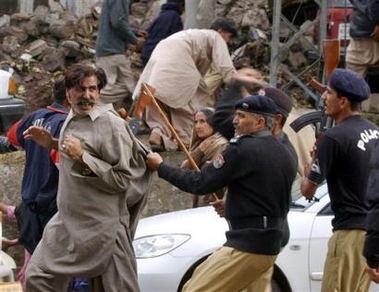
MUZAFFARABAD, Pakistan - Pakistani police used bamboo canes and rifle butts to break up a march Friday by survivors of the Oct. 8 earthquake who were protesting their eviction from a makeshift camp. Several people were injured.

The violence broke out as about 200 people marched through a street in central Muzaffarabad, the quake-ravaged capital of Pakistani-held Kashmir. Some 50 police blocked the protesters' path, then began dispersing the crowd with rifle butts and canes.

Quake survivors have been setting up informal camps all over the city, most of them lacking adequate sanitation and considered to constitute a public health risk. The camp in question is in a public park next to the town's collapsed library.

Several protesters responded by throwing rubble at the police, though the march had been largely peaceful.

Police defended their action, saying they were just trying to clear the road. Several people were dragged away but Arshad Jura, the officer in charge at the scene, said there no arrests.

One protester, Salim Shah, was left lying by the road.

"They ordered us to leave," he said, his tearful 12-year-old daughter Saima standing at his side. "They said they would come with bulldozers, so we protested. We have no other place to go."

The magnitude 7.6 quake centered in Kashmir killed about 86,000 people in Pakistani territory and another 1,350 in India. It left more than 3 million people homeless.

http://news.yahoo.com/s/ap/20051111/ap_on_re_as/south_asia_quake_protest

&gt;&gt;&gt;&gt;&gt;&gt;&gt;&gt;&gt;&gt;&gt;&gt;&gt;

AP - Fri Nov 11, 7:43 AM ET
Pakistani police officers grabsan an earthquake survivor during a protest in Muzaffarabad, Pakistan, Friday, Nov 11, 2005. Pakistani police using canes and rifle butts broke up a march Friday by earthquake survivors protesting their eviction from a makeshift refugee camp. Several demonstrators were injured and others arrested. (AP Photo/Achmad Ibrahim)

📎 aa
Đăng nhập để trả lời
0
Reuters - Thu Nov 10, 1:53 PM ET
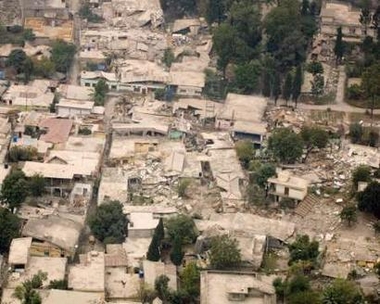
An aerial view of an earthquake-damaged area in Muzzafarabad November 10, 2005. Pakistan is urging 15,000 earthquake survivors who flooded into its small capital city to return and rebuild their homes in the country's hard-hit northern mountains, but many fear being forgotten as winter closes in. Many refugees living in tent settlements in Islamabad do not want to go back, despite promises by authorities to help reconstruct houses in areas devastated by the October 8, 2005 earthquake. REUTERS/Cpl Chris Hargreaves/RLCI/British Crown Copyright/Handout

📎 aaaa
Đăng nhập để trả lời
0
Reuters - Thu Nov 10,11:38 PM ET
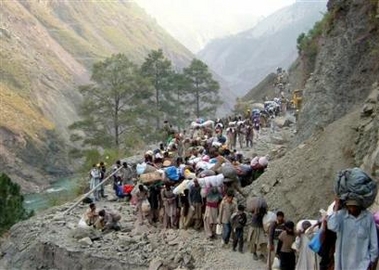
Kashmiri earthquake survivors walk on a road damaged by the October 8 earthquake in the Neelum Valley in northern Pakistan in this November 9, 2005 file photo. (Amiruddin Mughal/Files/Reuters)

📎 a
Đăng nhập để trả lời
0
Reuters - Fri Nov 11,10:10 AM ET
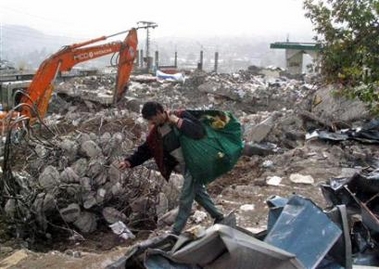
A Kashmiri earthquake survivor carries his belonging as he walks on a destroyed building in Muzaffarabad, the capital of Pakistan-administrated Kashmir, November 11, 2005. (Amiruddin Mughal/Reuters)

📎 abc
Đăng nhập để trả lời
0
Reuters - Fri Nov 11,10:49 AM ET
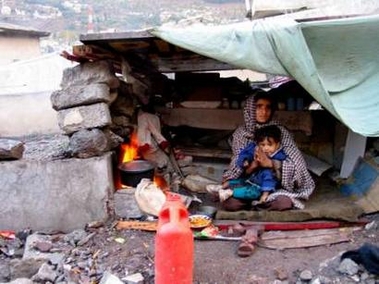
Pakistani earthquake survivors sit in their makeshift tent in Balakot, about 270km (167 miles) northwest of Islamabad, November 10, 2005. Pakistani police wielded batons against people living in a tent camp in the earthquake-hit city of Muzaffarabad on Friday, after they protested against plans to make them move. REUTERS/Ibrar Tanoli

📎 a
Đăng nhập để trả lời
0
Earthquake in Central China Kills 14

46 minutes ago

BEIJING - An earthquake with a magnitude of at least 5.5 shook part of central China on Saturday, killing at least 14 people and injuring nearly 400.

The official Xinhua News Agency said the quake happened at about 9 a.m., with the epicenter in Ruichang, a city of 420,000 in Jiangxi province.

Hundreds of homes collapsed and thousands were damaged, Xinhua said.

"The earthquake this morning was quite scary," said a shopkeeper in Ruichang reached by telephone who would only give her surname, Zhou.

Many people in Ruichang were staying outside for fear of aftershocks. Zhou said she felt a milder trembling at about 1 p.m.

Chinese Central Television news showed rows of crumbled brick buildings and deep cracks in the walls of many still standing.

The news showed a young boy with his head heavily bandaged and a man crying on a bench as he cradled an injured leg. An old man and his injured wife shared a cot at a makeshift medical center set up in the street.

Tents were set up outside a hospital treating some of the 377 injured. Xinhua said 1,000 tents were being sent to the area.

China's state Seismological Bureau said the quake was magnitude 5.7, while the U.S. Geological Survey in Golden, Colo., reported it was 5.5.

http://news.yahoo.com/s/ap/20051126/ap_on_re_as/china_quake
Đăng nhập để trả lời
0
Strong Earthquake Rattles Iran, Killing 10


By NASSER KARIMI, Associated Press Writer
Sun Nov 27, 6:19 PM ET


TEHRAN, Iran - An earthquake with a magnitude of at least 5.9 shook a sparsely populated area of southern Iran on Sunday, flattening seven villages, killing 10 people and injuring 70, officials and state-run television said. The temblor was felt as far away as Oman and the United Arab Emirates.

Heidar Alishvandi, the governor of Qeshm, was quoted by state television as saying rescue teams were deployed to the affected area, and people in the wrecked villages moved quickly to safely.

Another provincial official, Ghasem Karami, told The Associated Press that high casualties were not expected because the area was not heavily developed.

Tehran's seismologic center said the quake was of magnitude 5.9, but the U.S. Geological Survey in Golden, Colo., said it had a magnitude of 6.1. A magnitude-6.0 quake can cause severe damage.

Iran's seismologic center said the epicenter was in the waters of the Persian Gulf between the port city of Bandar Abbas and Qeshm Island, about 940 miles south of Tehran. The USGS said the quake was 35 miles southwest of Bandar Abbas, which has about 500,000 residents.

Masoud Dalman, head of Hormozgan province's emergency affairs, said several buildings on Qeshm Island were damaged. The island has about 200,000 residents.

State-run TV reported that Qeshm Island's airport sustained minor damage and part of a major hospital collapsed from the force of the quake. No further details were provided.

Shahram Alamdari, head of Iranian Red Crescent's rescue unit, said two helicopters were evacuating the injured from Qeshm to Bandar Abbas.

Iranian television ran video from Qeshm showing minor damages to some buildings and a few injured people being taken to hospitals. The report said the villages of Karavan and Kousheh were worst hit, but no footage was shown from those sites.

The quake cut telephone links between Qeshm Island and the mainland, the report said.

In Oman and the United Arab Emirates, buildings were evacuated and people fled into the streets.

"Power and water supplies were not affected," said Alireza Khorshidzadeh, a local journalist. "People poured into the streets, fearing aftershocks."

In Dubai, one of the seven emirates of the UAE, several buildings in the skyscraper-lined central business district were evacuated. They included the twin Emirates Towers, the highest buildings on the main street, where many international corporations and Dubai government institutions have offices.

"It lasted around 30 seconds or so — you could feel the building moving and the coffee cups shaking," said public relations executive Bina Mathews.

Iran is located on a number of seismic fault lines and, on average, experiences at least one slight quake every day.

The last major quake to hit southern Iran was in February, when a magnitude-6.4 temblor rocked Zarand, a town of about 15,000 people in Kerman province, 602 miles southeast of Tehran. It killed 612 people and injured more than 1,400, leveling several villages and leaving thousands of people homeless.

http://news.yahoo.com/s/ap/20051127/ap_on_re_mi_ea/iran_earthquake_14
Đăng nhập để trả lời
0


http://www.voanews.com/vietnamese/2005-11-27-voa6.cfm
Đăng nhập để trả lời
0
Monday, 17 October 2005, 15:32 GMT 16:32 UK


Overview: Quake aftermath

The 7.6 magnitude earthquake that struck close to Muzaffarabad in Pakistan-administered Kashmir on 8 October is known to have caused about 41,000 deaths and devastation it may take a decade to repair.
Pakistan confirmed 39,400 deaths without specifying how many of them occurred in its sector of Kashmir while India recorded 1,330 in its sector. Tens of thousands were injured and at least two million left homeless in the quake zone, the vast majority of them in Pakistan-administered Kashmir.

A senior United Nations relief official in Pakistan, Andrew McLeod, says there are not enough winter-weight tents in the world to provide the shelter needed by the survivors as winter closes in. Poor weather and mountainous terrain have also delayed the huge aid effort as fears mount of a "second wave" of deaths from untreated injuries and exposure.

Click on the highlighted labels on the map below to find out more about the situation in each area.

http://news.bbc.co.uk/1/hi/world/south_asia/4322624.stm
Đăng nhập để trả lời
0
Kashmiris Believe Quake Can Bring Peace

By TIM SULLIVAN, Associated Press Writer
Mon Oct 17, 3:44 PM ET

MUZAFFARABAD, Pakistan - In the byzantine, violent politics of Kashmir, it has always been about perspective.

To India, this quake-savaged city is in "Pakistani-Occupied Kashmir," an area it insists was stolen from it in 1947. To Pakistan, it's the capital of "Independent" Kashmir. But when the Oct. 8 earthquake struck, the destruction crossed the divided region.

While Pakistan suffered far worse — the death toll there rose Saturday to 38,000, most in Kashmir — at least 1,350 people were killed in the Indian sector.

That tragedy, some Kashmiris believe, has created an opportunity to accelerate the two nations' often-stumbling peace effort, and bring calm back to the beautiful pine-forested mountain region once famed as a place of learning and tolerance. At the very least, they say, it is a time when India and Pakistan must work together.

"This tragedy has not respected the cease-fire line," Mirwaiz Umar Farooq, the region's foremost Islamic leader and a prominent separatist in Indian-controlled Kashmir, told reporters after the quake.

Farooq urged the two countries to launch a joint effort for quake relief, and make it easier for Kashmiris to cross the frontier. "We have seen that both India and Pakistan have been hesitant in accepting each other's relief ... let's not play politics over this."

The first signs were discouraging — a suicide bombing and miscues between rescuers on the two sides. But past examples show how a natural disaster can nurture peace.

In 1999, twin earthquakes in Turkey and Greece fostered what became known as "earthquake diplomacy," as the longtime rivals sent each other help. And the destruction wrought by the Asian tsunami in the Indonesian province of Aceh in December helped lead to a peace accord between the government and separatist rebels.

"Sometimes a small event changes the course of history," said Nusrat Bano, a retired professor of Central Asian studies living in Indian-controlled Kashmir. The quake "has generated a feeling in people that if God's wrath doesn't discriminate between the two Kashmirs, why should the world be so adamant in keeping them apart?"

The quake, she said, could boost the slow-moving India-Pakistan peace process.

But when it comes to Kashmir, politics usually means trouble.

"We have been the main problem between India and Pakistan since 1947 ... It's always been about Kashmir," said Farooq Awan, 25, a civil servant walking with friends through Muzaffarabad, his hometown, where more than 10,000 died and much of the city was destroyed. Awan was lucky: His home and family were spared.

He doubts the quake can do much to bring India and Pakistan together.

"India is offering help, but I don't think Pakistan trusts India," he said.

The two countries' relations are rooted in distrust. They were born in 1947, when Britain gave independence to its Indian colony by dividing it into largely Hindu India and overwhelmingly Muslim Pakistan. The communal violence of partition, as that time was called, led to more than 1 million deaths.

Kashmir, then technically a British protectorate and not a part of colonial India, was caught in the middle. Largely Muslim but ruled by a Hindu king, it was given the choice of which nation to join. The king, insisting he wanted to remain independent, dithered until tribal raiders attacked from Pakistan. When he asked India for help, there was a steep price: union with India.

War broke out between India and Pakistan, and the eventual cease-fire line became the de facto border that still splits the territory.

The division laid the foundation for decades of Indian-Pakistani enmity and two more all-out wars. It also crushed the cosmopolitan culture called "Kashmiriyat," which recognized Kashmir's differences but didn't keep its people apart.

Those differences are legion: over a dozen languages and dialects, followers of Asia's major religions, and a range of ethnic groups.

As the Muslim insurgency against Indian rule took hold in the early 1990s, Hindus fled the verdant Kashmir Valley, the region's historic heart, and today it is one of the world's most dangerous places. Its myriad militant groups, demanding independence or union with Pakistan since 1989, dismiss the current India-Pakistan peace process and are still waging a fight that has killed some 65,000 people.

Immediately after the quake, India dispatched its first planeload of relief supplies to the Pakistani side, but when it announced that a group of its soldiers had crossed the heavily fortified cease-fire line to help Pakistani soldiers struggling with a damaged bunker, there was a rush of denials.

Pakistan called the announcement "totally concocted," insisting none of its bunkers had been harmed. Then India itself backed away, saying its soldiers had done nothing but lend the Pakistanis a few shovels and a pickax.

Meanwhile, after slowing for a few days, with at least one militant group saying it would suspend hostilities, the insurgent violence surged again. On Thursday, a bomber blew herself up near an Indian army convoy, the first such attack by a woman in Kashmir. Responsibility was claimed on behalf of a Pakistan-based militant movement, Jaish-e-Mohammad.

Despite the peace process that began last year, India accuses Pakistan of still aiding and arming militants training in Pakistani-controlled Kashmir — a charge Islamabad denies.

History also offers up at least a couple other reasons to be pessimistic.

While there were hopes in Sri Lanka that the Dec. 26 tsunami would push its faltering peace process, as it did in Indonesia, hope has since dwindled.

And after India's Gujarat earthquake killed more than 13,000 people in 2001, Pakistan sent two planeloads of aid.

Less than one year later, the two nations again nearly went to war.

___

Associated Press Writer Mujtaba Ali Ahmad contributed to this report from Srinagar, in Indian Kashmir.

http://news.yahoo.com/s/ap/20051017/ap_on_re_as/quake_kashmir_s_future_pk1_1
Đăng nhập để trả lời
0
AP - Mon Oct 17,12:53 PM ET
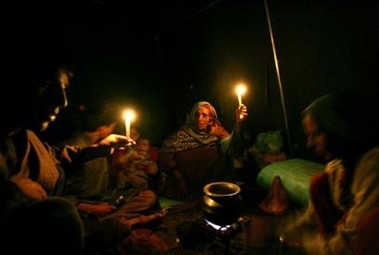
Earthquake victims prepare supper in a tent at the border village of Jabala 106 kilometers (66.25 miles) from north of Srinagar, India, Monday, Oct. 17, 2005. Torrential rain and snow hampered relief operations in earthquake-hit parts of Indian-controlled Kashmir for the second day Monday as roads to the worst-affected Uri and Tangdhar areas were cut off from the rest of the Himalayan province, where tens of thousands of people are seeking relief after last week's devastating earthquake. (AP Photo/Manish Swarup)

📎 asd
Đăng nhập để trả lời
0
AP - Sat Oct 29, 8:47 AM ET
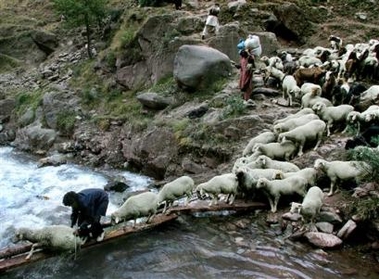
Pakistani earthquake survivors help their sheep cross a river as they walk down from their mountain villages near Kawai, Pakistan, on the road to Balakot Saturday, Oct. 29, 2005. Scores of Pakistanis, left homeless by the Oct. 8 earthquake, are migrating to lower land before the harsh winter arrives to cut them off from aid. (AP Photo/David Guttenfelder)

📎 as
Đăng nhập để trả lời
0
AP - Sat Oct 29,10:49 AM ET
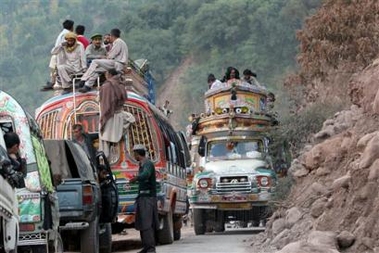
People wait in blocked traffic in Jhelum valley as Pakistani army buldozers try to open the destroyed road to Kashmiri town of Chinari, 76 kilometers ( 50 miles ) east of Muzaffarabad, Pakistan, Saturday, Oct. 29, 2005. Scores of Pakistanis, left homeless by the Oct. 8 earthquake, are migrating to lower land before the harsh winter arrives to cut them off from aid. (AP Photo/Burhan Ozbilici)

📎 aa
Đăng nhập để trả lời
0
«« « 1 2 » »»