
Diễn Đàn » English Club

Africa Disasters

7 trả lời, 6.126 lượt xem — Trang 1 / 1
Earthquake Kills Several People in Congo

By RODRIQUE NGOWI, Associated Press Writer
21 minutes ago

NAIROBI, Kenya - A powerful earthquake struck the Lake Tanganyika region of East Africa on Monday, toppling dozens of homes in a Congolese town and burying children in the rubble, aid workers said. Several people were reported killed.

The quake, with a preliminary magnitude of 6.8, struck at 2:20 p.m. (7:20 a.m. EST) and was centered near the Congo-Tanzania border, about 600 miles southwest of the Kenyan capital, the U.S. Geological Survey said on its Web site.

"Dozens of houses have collapsed, several children were buried by the roofs of their houses," said Jean-Donne Owali, a Congolese humanitarian worker in the lakeside town of Kalemie, Congo, about 35 miles from the epicenter.

"Injured people have been sent to local hospitals," Owali told The Associated Press by telephone. He said he saw children at one clinic bleeding from head injuries after their mud-and-thatch homes collapsed on them.

U.N. spokesman Michel Bonnardeaux said an unknown number of people were killed by collapsing houses and roofs, but exact figures were not immediately available. The desperately poor region has camps for tens of thousands of refugees from wars and economic collapse in Congo and Burundi.

The quake also sent panicked people running from buildings in Kigoma, the main Tanzanian transport hub on the shores of Lake Tanganyika about 90 miles from the epicenter, said regional commissioner Elmon Mahawa. He said there were no immediate reports of casualties in the town.

The USGS said the quake was located about six miles below the surface, and shook the ground in Nairobi and the Kenyan coastal city of Mombasa. It was also felt on the shores of Lake Victoria, Africa's largest lake, and in Tanzanian towns bordering Zambia and Malawi, Tanzania's meteorological chief Mohamed Mhita said by phone from the country's commercial capital, Dar es Salaam.

Henri Burgard, U.N. spokesman in the Congolese town of Uvira, said the quake lasted 30 seconds. "The buildings shook quite strongly. We have no reports of deaths so far," he said.

In Bujumbura, the capital of the central African nation of Burundi, an Associated Press reporter felt the three-story building sway in two waves of the quake.

The region is located along the Great Rift Valley, which runs for 3,000 miles between Syria and Mozambique.

___

Associated Press reporters Tom Maliti in Nairobi, Kenya, and Aloys Niyoyita in Bujumbura, Burundi, contributed to this report.

http://news.yahoo.com/s/ap/20051205/ap_on_re_af/east_africa_earthquake
Đăng nhập để trả lời
0
AP - Mon Dec 5, 8:54 AM ET
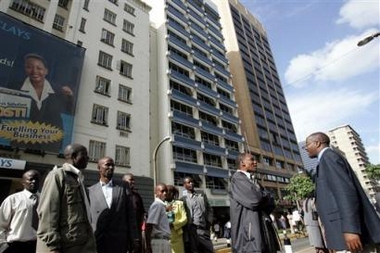
Kenyans gather outside office buildings, Monday, Dec. 5, 2005 after they evacuated the buildings after an earthhquake hit the area.A powerful earthquake hit the Lake Tanganyika area of central Africa and was felt as far away as the Kenyan coast Monday.The United States Geological Survey said its 6.8 measurement was preliminary and located the epicenter in the area of Lake Tanganyika, between Congo and Tanzania.(AP Photo/Karel Prinsloo)

📎 123
Đăng nhập để trả lời
0
Magnitude 7.5 Earthquake Hits Mozambique


By EMMANUEL CAMILLO, Associated Press Writer
19 minutes ago


MAPUTO, Mozambique - A powerful earthquake struck Mozambique early Thursday morning, shaking buildings and forcing people from hundreds of miles around to dash into the streets for safety. There were no immediate reports of injuries.

The magnitude-7.5 quake struck at 12:19 a.m. in southern Mozambique, 140 miles southwest of the coastal city of Beira, the U.S. Geological Survey said. The temblor was felt in neighboring Zimbawe and as far south as Durban, South Africa, 800 miles away.

Elias Daudi, Mozambique's national director of energy, said on state radio that authorities still do not have any information on casualties or the extent of the damage. He also urged people not to return to their buildings because of possible aftershocks.

In Berira, Tivoli Hotel manager Johana Neves said none of her guests was hurt but many tourists awoke and ran terrified from the building.

"It felt like the building was going to fall down and it went on for a long time, the trembling," she said by telephone. "It felt like you were in a boat, it was shaking everything yet, it's strange, nothing is broken, even the windows."

Hotel guest Antonio Dinis said the streets were full of people afraid to go back home.

State radio said there was an unconfirmed report of a collapsed building in Beira.

Buildings swayed in Maputo, the capital of the this Indian Ocean nation, 400 miles south of Beira. Radio reports said hundreds of people fled their homes for the street, as they did in Chimoyo, some 300 miles west of Beira near the border with Zimbabwe.

A newspaper editor in Maputo said he was in the 11th floor of an apartment building that was rocked by the quake.

"It shook a lot. We could feel it very strongly," Fernando Velosa, editor of Jornal de Mocambique, told Lisbon radio station TSF. Portugal is the former colonial ruler of the African nation.

The quake was shallow, which increases the potential for damage, said Dale Grant, a scientist with the USGS in Golden, Colo., which is a clearinghouse for temblors worldwide. A quake nearing magnitude 8 is capable of causing tremendous damage.

At least five aftershocks were immediately recorded and more were expected in the coming days because of the quake's size, USGS said.

The temblor occurred near the southern end of the East African rift system, a seismically active zone. Since 1900, the largest quake measured on the rift system had a magnitude-7.6, according to the USGS.

http://news.yahoo.com/s/ap/20060223/ap_on_re_af/mozambique_quake
Đăng nhập để trả lời
0


Mozambique Flag: Three equal horizontal bands of green (top), black, and yellow with a red isosceles triangle based on the hoist side; the black band is edged in white; centered in the triangle is a yellow five-pointed star bearing a crossed rifle and hoe in black superimposed on an open white book
Đăng nhập để trả lời
0
Source: Reuters Foundation
Date: 06 Aug 2006

Floods kill more than 100 in eastern Ethiopia
ADDIS ABABA, Aug 6 (Reuters)

Floods have killed more than 100 people and destroyed homes in eastern Ethiopia after heavy rains caused a river to overflow, police said on Sunday.

"Floods from the overflowing Dechatu river hit Dire Dawa town in the middle of Saturday night while residents were sleeping," police inspector Benyam Fikru told Reuters.

"The bodies of 101 residents washed away by the floods have been recovered by a joint police and army rescue operation."

He said rescuers, who launched their operation early on Sunday, were looking for more bodies.

"Bulldozers are digging into the sandy banks of the Dechatu river in search of more bodies," he said.

Benyam said some 220 residential houses had been destroyed by the floods.

Dire Dawa, located in Ethiopia's lowlands, is some 525 kms (326.2 miles) east of the capital Addis Ababa.

http://www.reliefweb.int/rw/RWB.NSF/db900SID/EVOD-6SEHA4?OpenDocument&rc=1&cc=eth
Đăng nhập để trả lời
0
<Bài viết đã được chỉnh sửa lúc 2006-08-07 05:35:33HongYen>
Ethiopia
Đăng nhập để trả lời
0


Description: Three equal horizontal bands of green (top), yellow, and red with a yellow pentagram and single yellow rays emanating from the angles between the points on a light blue disk centered on the three bands; Ethiopia is the oldest independent country in Africa, and the three main colors of her flag were so often adopted by other African countries upon independence that they became known as the pan-African colors.

http://education.yahoo.com/reference/factbook/et/flag.html;_ylt=AoR.HzTvPXkMwNoD.XvZ2vu4ecYF
Đăng nhập để trả lời
0
Ethiopia People:

Population:
73,053,286 (July 2005 est.)
note: Estimates for this country explicitly take into account the effects of excess mortality due to AIDS; this can result in lower life expectancy, higher infant mortality and death rates, lower population and growth rates, and changes in the distribution of population by age and sex than would otherwise be expected

Age structure:
0-14 years: 43.9% (male:16,082,504; female:15,999,602)
15-64 years: 53.4% (male:19,452,737; female:19,525,746)
65 years and over: 2.7% (male:905,648; female:1,087,049) (2005)

Median age:
total: 17.75 years
male: 17.64 years
female: 17.85 years (2005)

Population growth rate:
2.36% (2005 est.)

Birth rate:
38.61 births / 1,000 population (2005 est.)

Death rate:
15.06 deaths / 1,000 population (2005 est.)

Net migration rate:
0 migrant(s) / 1,000 population (2005 est.)
note: Repatriation of Ethiopians who fled to Sudan for refuge from war and famine in earlier years is expected to continue for several years; some Sudanese and Somali refugees, who fled to Ethiopia from the fighting or famine in their own countries, continue to return to their homes

Sex ratio:
at birth: 1.03 male(s)/female (2005)
under 15 years: 1.01 male(s)/female (2005)
15-64 years: 1 male(s)/female (2005)
65 years and over: 0.83 male(s)/female (2005)
total population: 1 male(s)/female (2005)

Infant mortality rate:
total: 95.32 deaths / 1,000 live births (2005 est.)
male: 105.3 deaths / 1,000 live births
female: 85.05 deaths / 1,000 live births

Life expectancy at birth:
total: 48.83 years (2005 est.)
male: 47.67 years
female: 50.03 years

Total fertility rate:
5.33 children born/woman (2005 est.)

HIV/AIDS — adult prevalence rate:
4.4% (2003 est.)

HIV/AIDS — people living with HIV/AIDS:
1.5 million (2003 est.)

HIV/AIDS — deaths:
120,000 (2003 est.)

Major infectious diseases:
degree of risk: very high
food or waterborne diseases: bacterial and protozoal diarrhea, hepatitis A, typhoid fever, and hepatitis E
vectorborne disease: malaria and cutaneous leishmaniasis are high risks in some locations
respiratory disease: meningococcal meningitis
animal contact disease: rabies
water contact disease: schistosomiasis (2004)

Nationality:
noun: Ethiopian(s)
adjective: Ethiopian

Ethnic groups:
Oromo 40%, Amhara and Tigre 32%, Sidamo 9%, Shankella 6%, Somali 6%, Afar 4%, Gurage 2%, other 1%

Religions:
Muslim 45-50%, Ethiopian Orthodox 35-40%, animist 12%, other 3-8%

Languages:
Amharic, Tigrinya, Oromigna, Guaragigna, Somali, Arabic, other local languages, English (major foreign language taught in schools)

Literacy:
definition: age 15 and over can read and write
total population: 42.7%
male: 50.3%
female: 35.1% (2003)

http://education.yahoo.com/reference/factbook/et/popula.html;_ylt=AiHIa03ayclneNpOSD.TMyq4ecYF
Đăng nhập để trả lời
0