The Lady of Loué so influenced her husband by her great patience and longsuffering, that she drew him from his evil ways, and they lived afterwards in greater love than before.
Bấy giờ có một người phu nhân thuộc dòng dõi Loué vốn vô cùng đoan trang và đức hạnh, đến nỗi được hết thảy chòm xóm yêu mến và kính trọng. Chồng bà hết mực tin tưởng giao phó cho bà mọi công việc trong nhà, và quả thực ông đã đặt đúng người; bà quán xuyến mọi sự khôn ngoan đến mức dưới bàn tay đảm lược của bà, dinh cơ nhà họ đã trở thành một trong những nơi sung túc và quang quẻ bậc nhất ở cả xứ Anjou lẫn Touraine.
In this fashion she lived a great while with her husband, to whom she bore several handsome children; but then, as happiness is always followed by its opposite, hers began to be lessened. Her husband, finding virtuous ease to be unendurable, laid it aside to seek for toil, and made it his wont to rise from beside his wife as soon as she was asleep, and not to return until it was nearly morning. The lady of Loué took this conduct ill, and falling into a deep unrest, of which she was fain to give no sign, neglected her household matters, her person and her family, like one that deemed herself to have lost the fruit of her toils, to wit, her husband’s exceeding love, for the preserving of which there was no pain that she would not willingly have endured. But having lost it, as she could see, she became careless of everything else in the house, and the lack of her care soon brought mischief to pass.
Chồng bà một mặt thì tiêu xài vô độ, mặt khác lại buông xuôi không thèm quản lý cơ ngơi, khiến chẳng bao lâu sau gia cảnh lâm vào cảnh rối ren tột độ, đến mức cây gỗ trong rừng cũng phải đốn đem bán và ruộng nương thì phải đem cầm cố.
One of her kinsfolk that had knowledge of her distemper, rebuked her for her error, saying that if love for her husband did not lead her to care for the advantage of his house, she should at least have regard to her poor children. Hereat her pity for them caused her to recover herself, and she tried all means to win back her husband’s love.
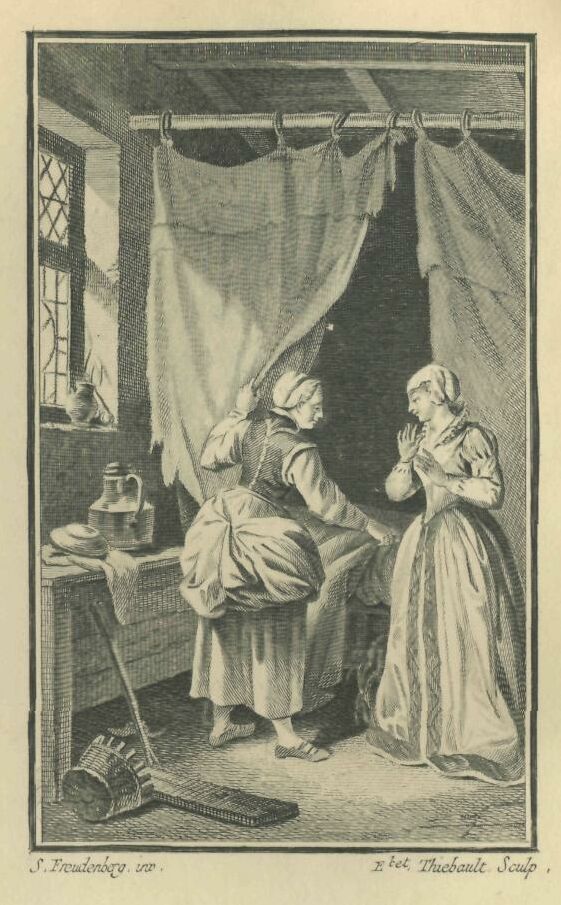
Trong cảnh ngộ ấy, bà bèn canh chừng cẩn thận suốt một đêm nọ, và khi chồng vừa rời khỏi ổ chăn, bà cũng trở dậy khoác áo choàng, dọn dẹp giường chiếu rồi quỳ gối cầu nguyện cho đến lúc chồng quay về. Lúc ông bước vào, bà ra đón, trao nụ hôn tình tứ và bưng tới một chậu nước đầy để ông rửa tay. Người chồng không khỏi ngạc nhiên trước thái độ khác thường này, bèn bảo rằng nàng hà tất phải thức giấc chi cho mệt nhọc bởi ông chỉ vừa đi từ nhà vệ sinh trở ra mà thôi; nghe vậy, phu nhân liền đáp rằng tuy chẳng phải chuyện lớn lao gì, nhưng việc rửa tay sạch sẽ sau khi đặt chân đến một nơi dơ bẩn hôi hạm dẫu sao vẫn là phép ứng xử phải lẽ. Ý bà muốn qua những lời ấy mà thức tỉnh, khiến ông phải ghê tởm lối sống trụy lạc của chính mình. Thế nhưng, dẫu vậy ông ta vẫn chứng nào tật nấy, và suốt ròng rã một năm trời, người vợ vẫn kiên trì hành xử như thế mà hoàn toàn công cốc.
Accordingly, seeing that this behaviour served her naught, one day, while she was waiting for her husband, who tarried longer than ordinary, she had a mind to go in search of him, and, passing from room to room, found him at last in a closet at the back of the house, lying asleep by the side of the ugliest, filthiest, and most vile serving-woman they had.
Dè đâu, nghĩ rằng phen này phải cho ông một bài học nhớ đời vì tội dám rũ bỏ người vợ hiền thục để chạy theo một ả đàn bà vừa bẩn thỉu vừa hạ tiện, bà liền vơ lấy một ít rơm rồi châm lửa đốt ngay giữa căn phòng; song khi nhận ra ngọn lửa ấy có khi thiêu cháy cả chồng mình nhanh chẳng kém gì lúc đánh thức ông dậy, bà liền giật mạnh lấy tay áo ông và cất giọng kêu lớn:
“Fire! fire!”
Nếu người chồng cảm thấy hổ thẹn và hối hận xiết bao khi bị một người vợ đoan chính bắt quả tang đang hú hò bên cạnh một ả nhơ nhuốc như vậy, thì quả thực ông ta có thừa lý do để mà muối mặt. Bấy giờ, người vợ mới từ tốn bảo rằng:
“For a year, sir, have I tried by gentle and patient means to draw you from this wickedness, and to show you that whilst washing the outside you should also cleanse that which is within. Finding that all I could do was of no avail, I have sought assistance from that clement which brings all things to an end, and I promise you, sir, that, if this do not mend you, I know not whether I shall a second time be able to deliver you from the danger as I have now done. I pray you remember that the deepest despair is that caused by love, and that if I had not had the fear of God before my eyes I could not have endured so much.”
Người chồng mừng rỡ vì thoát nạn trong gang tấc, liền thề thốt sẽ không bao giờ tái phạm hay làm tổn lòng vợ thêm lần nào nữa. Phu nhân rất sẵn lòng tin lời chồng, và với sự đồng thuận của ông, bà đã cho đuổi cổ người con tì nữ hỗn xược nợn nện kia đi nơi khác. Kể từ dạo ấy, vợ chồng họ sống bên nhau vô cùng đắm đuối thắm thiết, đến nỗi những lầm lỡ trong quá khứ nhờ kết cục tốt đẹp mang lại nay lại hóa thành thứ gia vị làm sâu sắc thêm tình nồng nghĩa đậm giữa hai người.
“Should God give you such husbands, ladies, I pray you despair not until you have fully tried all means to win them back. There are twenty-four hours in the day in which a man may change his mind, and a wife who has gained her husband over by patience and longsuffering should deem herself more fortunate than if fate and her kinsfolk had given her one more perfect.”
“It is an example,” said Oisille, “that all married women ought to follow.”
“Follow it who will,” said Parlamente; “for my own part, I should find it impossible to be patient so long. Although in every condition patience is a seemly virtue, yet I think that in wedded life it finally produces ill-will. For, when suffering is caused you by your partner, you are compelled to keep yourself as much apart from him as possible; and from such estrangement there springs up contempt for the faithless one; and this contempt gradually lessens love, for a thing is loved in proportion as it is esteemed.”
“But there is a danger,” said Ennasuite, “that the impatient wife may meet with a passionate husband who, instead of patience, will bring her pain.”
“And what more,” said Parlamente, “could a husband do than was done by the husband in the story?”
“What more?” said Ennasuite. “Why, beat his wife soundly, and make her lie in the smaller bed, and his sweetheart in the larger.” (2)
At this period, and for some time afterwards, there were usually two beds in the master’s room, a large one for himself and his wife, and a small one in which slept a trusty servant, male or female. These little beds are shown in some of the designs engraved by Abraham Bosse in the seventeenth century.—L.
“It is my belief,” said Parlamente, “that a true woman would be less grieved by being beaten in anger than by being contemned for one of less worth than herself. After enduring the severance of love, nothing that her husband could do would be able to cause her any further pain. And in this wise the story says that the trouble she took to regain him was for the sake of her children—which I can well believe.”
“And do you think that it showed great patience on her part,” said Nomerfide, “to kindle a fire beneath the bed on which her husband was sleeping.”
“Yes,” said Longarine; “for when she saw the smoke she waked him, and herein, perhaps, was she most to blame; for the ashes of such a husband as hers would to my thinking have been good for the making of lye.”
“You are cruel, Longarine,” said Oisille, “but those are not the terms on which you lived with your own husband.”
“No,” said Longarine, “for, God be thanked, he never gave me cause. I have reason to regret him all my life long, not to complain of him.”
“But if he had behaved in such a manner towards you,” said Nomerfide, “what would you have done?”
“I loved him so dearly,” said Longarine, “that I believe I should have killed him, and myself as well. To die after taking such a vengeance would have been sweeter to me than to live faithfully with the faithless.”
“So far as I can see,” said Hircan, “you do not love your husbands except for your own sakes. If they are what you want them to be, you are very fond of them; but if they fall into the slightest error towards you, they lose on a Saturday the toil of an entire week. Thus you are minded to rule, and I for my part will consent to it provided, however, that all other husbands agree.”
“It is reasonable,” said Parlamente, “that man should rule us as our head, but not that he should forsake us or treat us ill.”
“God has provided so wisely,” said Oisille, “both for man and for woman, that I hold marriage, if it be not abused, to be the goodliest and securest condition imaginable, and I am sure that, whatever they may seem to do, all here present think the same. And if the man claims to be wiser than the woman, he will be the more severely blamed should the fault come from him. But enough of such talk. Let us now see to whom Dagoucin will give his vote.”
“I give it,” he said, “to Longarine.”
“You do me a great pleasure,” she replied, “for I have read a story that is worthy to follow yours. Since we are set upon praising the virtuous patience of ladies, I will show you one more worthy of praise than she of whom we have just been speaking. And she is the more deserving of esteem in that she was a city dame, and therefore one of those whose breeding is less virtuous than that of others.”