[NỘI DUNG]:
First Description of Gadshill Place—Negociations for Purchase—Becomes
his Home in 1859—Gadshill a Century Ago—Antecedents of
Dickens's House—Exterior and Porch—Gradual Additions—Later
Changes—Swiss Châlet presented by Mr. Fechter—Dickens's
Writing-table—Making Gadshill his Home—Planting Trees—New
Conservatory—Course of Daily Life—Dickens's Dogs—A Dog with
a Taste—Favourite Walks—Cooling Churchyard.
"I was better pleased with Gadshill Place last
Saturday," he wrote to me from Paris on the 13th of
February 1856, "on going down there, even than I
had prepared myself to be. The country, against
every disadvantage of season, is beautiful; and the
house is so old fashioned, cheerful, and comfortable,
that it is really pleasant to look at. The good old
Rector now there, has lived in it six and twenty years,
so I have not the heart to turn him out. He is to
remain till Lady-Day next year, when I shall go in,
please God; make my alterations; furnish the house;
and keep it for myself that summer." Returning to
England through the Kentish country with Mr. Wilkie
Collins in July, other advantages occurred to him. "A
railroad opened from Rochester to Maidstone, which
connects Gadshill at once with the whole sea coast, is
certainly an addition to the place, and an enhancement[203]
of its value. Bye and bye we shall have the
London, Chatham and Dover, too; and that will bring
it within an hour of Canterbury and an hour and a[204]
half of Dover. I am glad to hear of your having been
in the neighbourhood. There is no healthier (marshes
avoided), and none in my eyes more beautiful. One
of these days I shall show you some places up the
Medway with which you will be charmed."
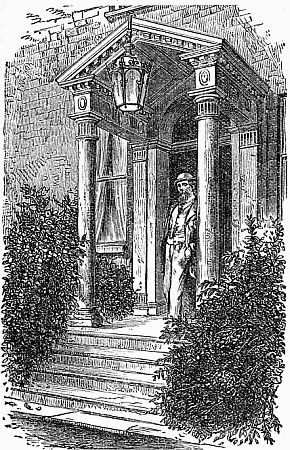
THE PORCH AT GADSHILL.
The association with his youthful fancy that first
made the place attractive to him has been told; and
it was with wonder he had heard one day, from his
friend and fellow worker at Household Words, Mr. W.
H. Wills, that not only was the house for sale to which
he had so often looked wistfully, but that the lady
chiefly interested as its owner had been long known
and much esteemed by himself. Such curious chances
led Dickens to his saying about the smallness of the
world; but the close relation often found thus existing
between things and persons far apart, suggests not so
much the smallness of the world as the possible importance
of the least things done in it, and is better
explained by the grander teaching of Carlyle, that
causes and effects, connecting every man and thing
with every other, extend through all space and time.
It was at the close of 1855 the negociation for its
purchase began. "They wouldn't," he wrote (25th of
November), "take £1700 for the Gadshill property, but
'finally' wanted £1800. I have finally offered £1750.
It will require an expenditure of about £300 more
before yielding £100 a year." The usual discovery
of course awaited him that this first estimate would
have to be increased threefold. "The changes absolutely
necessary" (9th of February 1856) "will take
a thousand pounds; which sum I am always resolving
to squeeze out of this, grind out of that, and wring[205]
out of the other; this, that, and the other generally
all three declining to come up to the scratch for the
purpose." "This day,"[219] he wrote on the 14th of
March, "I have paid the purchase money for Gadshill
Place. After drawing the cheque (£1790) I turned
round to give it to Wills, and said, 'Now isn't it an
extraordinary thing—look at the Day—Friday! I have
been nearly drawing it half a dozen times when the
lawyers have not been ready, and here it comes round
upon a Friday as a matter of course.'" He had no
thought at this time of reserving the place wholly for
himself, or of making it his own residence except at
intervals of summer. He looked upon it as an investment
only. "You will hardly know Gadshill again,"
he wrote in January 1858, "I am improving it so much—yet
I have no interest in the place." But continued
ownership brought increased liking; he took more and
more interest in his own improvements, which were
just the kind of occasional occupation and resource
his life most wanted in its next seven or eight years;
and any farther idea of letting it he soon abandoned
altogether. It only once passed out of his possession
thus, for four months in 1859; in the following year,
on the sale of Tavistock House, he transferred to it his
books and pictures and choicer furniture; and thenceforward,
varied only by houses taken from time to time
for the London season, he made it his permanent
family abode. Now and then, even during those years,[206]
he would talk of selling it; and on his last return from
America, when he had sent the last of his sons out into
the world, he really might have sold it if he could
then have found a house in London suitable to him,
and such as he could purchase. But in this he failed;
secretly to his own satisfaction, as I believe; and thereupon,
in that last autumn of his life, he projected and
carried out his most costly addition to Gadshill.
Already of course more money had been spent upon it
than his first intention in buying it would have justified.
He had so enlarged the accommodation, improved the
grounds and offices, and added to the land, that, taking
also into account this final outlay, the reserved price
placed upon the whole after his death more than quadrupled
what he had given in 1856 for the house, shrubbery,
and twenty years' lease of a meadow field. It
was then purchased, and is now inhabited, by his
eldest son.
Its position has been described, and one of the last-century-histories
of Rochester quaintly mentions the
principal interest of the locality. "Near the twenty-seventh
stone from London is Gadshill, supposed to
have been the scene of the robbery mentioned by
Shakespeare in his play of Henry IV; there being reason
to think also that it was Sir John Falstaff, of truly
comic memory, who under the name of Oldcastle inhabited
Cooling Castle of which the ruins are in the
neighbourhood. A small distance to the left appears
on an eminence the Hermitage the seat of the late Sir
Francis Head, Bart;[220] and close to the road, on a small[207]
ascent, is a neat building lately erected by Mr. Day.
In descending Strood-hill is a fine prospect of Strood,
Rochester, and Chatham, which three towns form a
continued street extending above two miles in length."
It had been supposed[221] that "the neat building lately
erected by Mr. Day" was that which the great novelist
made famous; but Gadshill Place had no existence until
eight years after the date of the history. The good
rector who so long lived in it told me, in 1859, that it
had been built eighty years before by a then well-known
character in those parts, one Stevens, father-in-law of
Henslow the Cambridge professor of botany. Stevens,
who could only with much difficulty manage to write
his name, had begun life as ostler at an inn; had become
husband to the landlord's widow; then a brewer;
and finally, as he subscribed himself on one occasion,
"mare" of Rochester. Afterwards the house was inhabited
by Mr. Lynn (from some of the members of
whose family Dickens made his purchase); and, before
the Rev. Mr. Hindle became its tenant, it was inhabited
by a Macaroni parson named Townshend, whose
horses the Prince Regent bought, throwing into the
bargain a box of much desired cigars. Altogether the
place had notable associations even apart from those
which have connected it with the masterpieces of English
humour. "This House, Gadshill Place, stands[208]
on the summit of Shakespeare's Gadshill, ever memorable
for its association with Sir John Falstaff in his
noble fancy. But, my lads, my lads, to-morrow morning,
by four o'clock, early at Gadshill! there are pilgrims
going to Canterbury with rich offerings, and traders riding
to London with fat purses: I have vizards for you
all; you have horses for yourselves." Illuminated by
Mr. Owen Jones, and placed in a frame on the first-floor
landing, these words were the greeting of the new
tenant to his visitors. It was his first act of ownership.
All his improvements, it should perhaps be remarked,
were not exclusively matters of choice; and to illustrate
by his letters what befell at the beginning of his changes,
will show what attended them to the close. His earliest
difficulty was very grave. There was only one spring
of water for gentlefolk and villagers, and from some of
the houses or cottages it was two miles away. "We are
still" (6th of July) "boring for water here, at the rate
of two pounds per day for wages. The men seem to
like it very much, and to be perfectly comfortable."
Another of his earliest experiences (5th of September)
was thus expressed: "Hop-picking is going on, and
people sleep in the garden, and breathe in at the keyhole
of the house door. I have been amazed, before
this year, by the number of miserable lean wretches,
hardly able to crawl, who go hop-picking. I find it is
a superstition that the dust of the newly picked hop,
falling freshly into the throat, is a cure for consumption.
So the poor creatures drag themselves along the roads,
and sleep under wet hedges, and get cured soon and
finally." Towards the close of the same month (24th
of September) he wrote: "Here are six men perpetually[209]
going up and down the well (I know that somebody
will be killed), in the course of fitting a pump;
which is quite a railway terminus—it is so iron, and
so big. The process is much more like putting Oxford-street
endwise, and laying gas along it, than anything else.
By the time it is finished, the cost of this water will be
something absolutely frightful. But of course it proportionately
increases the value of the property, and
that's my only comfort. . . . The horse has gone lame
from a sprain, the big dog has run a tenpenny nail into
one of his hind feet, the bolts have all flown out of the
basket-carriage, and the gardener says all the fruit trees
want replacing with new ones." Another note came
in three days. "I have discovered that the seven miles
between Maidstone and Rochester is one of the most
beautiful walks in England. Five men have been looking
attentively at the pump for a week, and (I should
hope) may begin to fit it in the course of October." . . .
With even such varying fortune he effected other
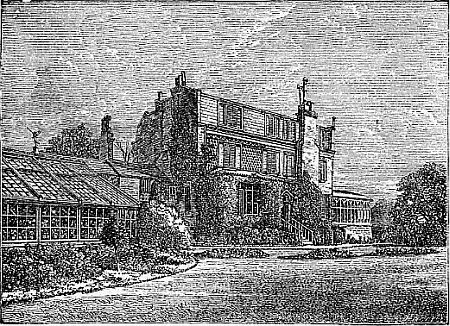
changes.[222] The exterior remained to the last much as
it was when he used as a boy to see it first; a plain,
old-fashioned, two-story, brick-built country house,
with a bell-turret on the roof, and over the front door
a quaint neat wooden porch with pillars and seats.
But, among his additions and alterations, was a new
drawing-room built out from the smaller existing one,[210]
both being thrown together ultimately; two good bedrooms
built on a third floor at the back; and such rearrangement
of the ground floor as, besides its handsome
drawing-room, and its dining-room which he
hung with pictures, transformed its bedroom into a
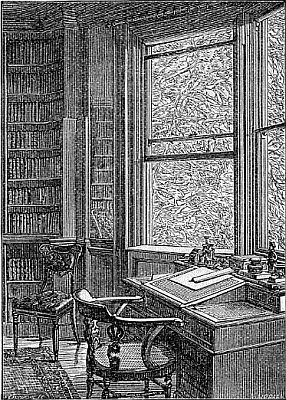
study which he lined with books and sometimes wrote
in, and changed its breakfast-parlour into a retreat
fitted up for smokers into which he put a small billiard-table.
These several rooms opened from a hall
having in it a series of Hogarth prints, until, after the
artist's death, Stanfield's noble scenes were placed
there, when the Hogarths were moved to his bedroom;
and in this hall, during his last absence in America, a
parquet floor was laid down. Nor did he omit such
changes as might increase the comfort of his servants.
He built entirely new offices and stables, and replaced
a very old coach-house by a capital servants' hall,
transforming the loft above into a commodious school-room
or study for his boys. He made at the same
time an excellent croquet-ground out of a waste piece
of orchard.
Belonging to the house, but unfortunately placed on
the other side of the high road, was a shrubbery, well
wooded though in desolate condition, in which stood
two magnificent cedars; and having obtained, in 1859,
the consent of the local authorities for the necessary
underground work, Dickens constructed a passage beneath
the road[223] from his front lawn; and in the[211]
shrubbery thus rendered accessible, and which he then
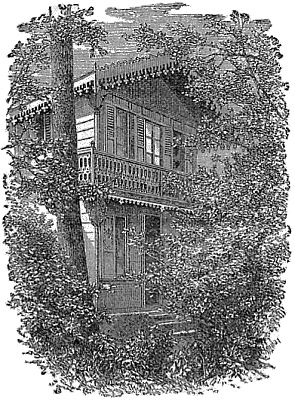
laid out very prettily, he placed afterwards a Swiss
châlet[224] presented to him by Mr. Fechter, which arrived
from Paris in ninety-four pieces fitting like the
joints of a puzzle, but which proved to be somewhat
costly in setting on its legs by means of a foundation
of brickwork. Once up, however, it was a great resource
in the summer months, and much of Dickens's
work was done there. "I have put five mirrors in the
châlet where I write,"[225] he told an American friend,[212]
"and they reflect and refract, in all kinds of ways, the
leaves that are quivering at the windows, and the great
fields of waving corn, and the sail-dotted river. My
room is up among the branches of the trees; and the
birds and the butterflies fly in and out, and the green
branches shoot in at the open windows, and the lights
and shadows of the clouds come and go with the rest
of the company. The scent of the flowers, and indeed
of everything that is growing for miles and miles, is
most delicious." He used to make great boast, too,
not only of his crowds of singing birds all day, but
of his nightingales at night.
THE CHÂLET.
One or two more extracts from letters having reference
to these changes may show something of the
interest to him with which Gadshill thus grew under
his hands. A sun-dial on his back-lawn had a bit of
historic interest about it. "One of the balustrades of[213]
the destroyed old Rochester Bridge," he wrote to his
daughter in June 1859, "has been (very nicely) presented
to me by the contractors for the works, and
has been duly stone-masoned and set up on the lawn
behind the house. I have ordered a sun-dial for the
top of it, and it will be a very good object indeed."
"When you come down here next month," he wrote
to me, "we have an idea that we shall show you rather[214]
a neat house. What terrific adventures have been in
action; how many overladen vans were knocked up
at Gravesend, and had to be dragged out of Chalk-turnpike
in the dead of the night by the whole equine
power of this establishment; shall be revealed at
another time." That was in the autumn of 1860,
when, on the sale of his London house, its contents
were transferred to his country home. "I shall have
an alteration or two to show you at Gadshill that
greatly improve the little property; and when I get
the workmen out this time, I think I'll leave off."
October 1861 had now come, when the new bedrooms
were built; but in the same month of 1863 he announced
his transformation of the old coach-house.
"I shall have a small new improvement to show you
at Gads, which I think you will accept as the crowning
ingenuity of the inimitable." But of course it was not
over yet. "My small work and planting," he wrote
in the spring of 1866, "really, truly, and positively
the last, are nearly at an end in these regions, and the
result will await summer inspection." No, nor even
yet. He afterwards obtained, by exchange of some
land with the trustees of Watts's Charity, the much
coveted meadow at the back of the house of which
heretofore he had the lease only; and he was then
able to plant a number of young limes and chestnuts
and other quick-growing trees. He had already planted
a row of limes in front. He had no idea, he would
say, of planting only for the benefit of posterity, but
would put into the ground what he might himself enjoy
the sight and shade of. He put them in two or three
clumps in the meadow, and in a belt all round.[215]
Still there were "more last words," for the limit
was only to be set by his last year of life. On
abandoning his notion, after the American Readings,
of exchanging Gadshill for London, a new staircase
was put up from the hall; a parquet floor laid on
the first landing; and a conservatory built, opening
into both drawing-room and dining-room, "glass and
iron," as he described it, "brilliant but expensive, with
foundations as of an ancient Roman work of horrible
solidity." This last addition had long been an object
of desire with him; though he would hardly even now
have given himself the indulgence but for the golden
shower from America. He saw it first in a completed
state on the Sunday before his death, when his younger
daughter was on a visit to him. "Well, Katey," he
said to her, "now you see positively the last improvement
at Gadshill;" and every one laughed at the joke
against himself. The success of the new conservatory
was unquestionable. It was the remark of all around
him that he was certainly, from this last of his improvements,
drawing more enjoyment than from any
of its predecessors, when the scene for ever closed.
HOUSE AND CONSERVATORY: FROM THE MEADOW.
Of the course of his daily life in the country there
is not much to be said. Perhaps there was never a man
who changed places so much and habits so little. He
was always methodical and regular; and passed his life
from day to day, divided for the most part between
working and walking, the same wherever he was. The
only exception was when special or infrequent visitors
were with him. When such friends as Longfellow and
his daughters, or Charles Eliot Norton and his wife,
came, or when Mr. Fields brought his wife and Professor[216]
Lowell's daughter, or when he received other
Americans to whom he owed special courtesy, he would
compress into infinitely few days an enormous amount
of sight seeing and country enjoyment, castles, cathedrals,
and fortified lines, lunches and picnics among
cherry orchards and hop-gardens, excursions to Canterbury
or Maidstone and their beautiful neighbourhoods,
Druid-stone and Blue Bell Hill. "All the
neighbouring country that could be shown in so short
a time," he wrote of the Longfellow visit, "they saw.
I turned out a couple of postilions in the old red jackets
of the old red royal Dover road for our ride, and it
was like a holiday ride in England fifty years ago."
For Lord Lytton he did the same, for the Emerson
Tennents, for Mr. Layard and Mr. Helps, for Lady[217]
Molesworth and the Higginses (Jacob Omnium), and
such other less frequent visitors.
Excepting on such particular occasions however, and
not always even then, his mornings were reserved
wholly to himself; and he would generally preface his
morning work (such was his love of order in everything
around him) by seeing that all was in its place in the
several rooms, visiting also the dogs, stables, and
kitchen garden, and closing, unless the weather was
very bad indeed, with a turn or two round the meadow
before settling to his desk. His dogs were a great
enjoyment to him;[226] and, with his high road traversed[218]
as frequently as any in England by tramps and wayfarers
of a singularly undesirable description, they were
also a necessity. There were always two, of the mastiff
kind, but latterly the number increased. His own
favourite was Turk, a noble animal, full of affection
and intelligence, whose death by a railway-accident,
shortly after the Staplehurst catastrophe, caused him
great grief. Turk's sole companion up to that date
was Linda, puppy of a great St. Bernard brought over
by Mr. Albert Smith, and grown into a superbly beautiful
creature. After Turk there was an interval of an
Irish dog, Sultan, given by Mr. Percy Fitzgerald; a
cross between a St. Bernard and a bloodhound, built
and coloured like a lioness and of splendid proportions,
but of such indomitably aggressive propensities, that,
after breaking his kennel-chain and nearly devouring a
luckless little sister of one of the servants, he had to
be killed. Dickens always protested that Sultan was a
Fenian, for that no dog, not a secretly sworn member
of that body, would ever have made such a point,
muzzled as he was, of rushing at and bearing down
with fury anything in scarlet with the remotest resemblance
to a British uniform. Sultan's successor was
Don, presented by Mr. Frederic Lehmann, a grand
Newfoundland brought over very young, who with
Linda became parent to a couple of Newfoundlands,
that were still gambolling about their master, huge,
though hardly out of puppydom, when they lost him.
He had given to one of them the name of Bumble,
from having observed, as he described it, "a peculiarly
pompous and overbearing manner he had of appearing
to mount guard over the yard when he was an absolute[219]
infant." Bumble was often in scrapes. Describing
to Mr. Fields a drought in the summer of 1868, when
their poor supply of ponds and surface wells had become
waterless, he wrote: "I do not let the great
dogs swim in the canal, because the people have to
drink of it. But when they get into the Medway, it is
hard to get them out again. The other day Bumble
(the son, Newfoundland dog) got into difficulties among
some floating timber, and became frightened. Don
(the father) was standing by me, shaking off the wet
and looking on carelessly, when all of a sudden he
perceived something amiss, and went in with a bound
and brought Bumble out by the ear. The scientific
way in which he towed him along was charming."
The description of his own reception, on his reappearance
after America, by Bumble and his brother, by the
big and beautiful Linda, and by his daughter Mary's
handsome little Pomeranian, may be added from his
letters to the same correspondent. "The two Newfoundland
dogs coming to meet me, with the usual
carriage and the usual driver, and beholding me coming
in my usual dress out at the usual door, it struck
me that their recollection of my having been absent
for any unusual time was at once cancelled. They
behaved (they are both young dogs) exactly in their
usual manner; coming behind the basket phaeton as
we trotted along, and lifting their heads to have their
ears pulled, a special attention which they receive from
no one else. But when I drove into the stable-yard,
Linda (the St. Bernard) was greatly excited; weeping
profusely, and throwing herself on her back that she
might caress my foot with her great fore-paws. Mary's[220]
little dog too, Mrs. Bouncer, barked in the greatest
agitation on being called down and asked by Mary,
'Who is this?' and tore round and round me like the
dog in the Faust outlines." The father and mother
and their two sons, four formidable-looking companions,
were with him generally in his later walks.
THE STUDY AT GADSHILL.
Round Cobham, skirting the park and village and
passing the Leather Bottle famous in the page of Pickwick,
was a favourite walk with Dickens. By Rochester
and the Medway, to the Chatham Lines, was
another. He would turn out of Rochester High-street
through The Vines (where some old buildings, from
one of which called Restoration-house he took Satis-house
for Great Expectations, had a curious attraction
for him), would pass round by Fort Pitt, and coming
back by Frindsbury would bring himself by some cross
fields again into the high road. Or, taking the other
side, he would walk through the marshes to Gravesend,
return by Chalk church, and stop always to have greeting
with a comical old monk who for some incomprehensible
reason sits carved in stone, cross-legged with
a jovial pot, over the porch of that sacred edifice.
To another drearier churchyard, itself forming part of the
marshes beyond the Medway, he often took friends to
show them the dozen small tombstones of various sizes
adapted to the respective ages of a dozen small children
of one family which he made part of his story of
Great Expectations, though, with the reserves always
necessary in copying nature not to overstep her modesty
by copying too closely, he makes the number that
appalled little Pip not more than half the reality.
About the whole of this Cooling churchyard, indeed,[221]
and the neighbouring castle ruins, there was a weird
strangeness that made it one of his attractive walks in
the late year or winter, when from Higham he could
get to it across country over the stubble fields; and,
for a shorter summer walk, he was not less fond of going
round the village of Shorne, and sitting on a hot afternoon
in its pretty shaded churchyard. But on the[222]
whole, though Maidstone had also much that attracted
him to its neighbourhood, the Cobham neighbourhood
was certainly that which he had greatest pleasure in;
and he would have taken oftener than he did the walk
through Cobham park and woods, which was the last
he enjoyed before life suddenly closed upon him,
but that here he did not like his dogs to follow.
Don now has his home there with Lord Darnley,
and Linda lies under one of the cedars at Gadshill.